Last updated: November 20, 2026
Your heart-healthy pantry is slowing weeknight cooking down. Quick answer: use a simple pantry organization system with three zones, one active shelf, and clear bins with labels so you can find dinner foods in seconds. The fix is a simple pantry organization system: zone shelves by meal use, keep the most-used foods at eye level, and store them in clear bins with labels. The steps below settle what goes where, what gets grouped together, and how to keep food from disappearing behind the old cans.
In short: Put the ingredients you reach for most often on the easiest shelf, group pantry shelves by meal type, and use bins plus labels so whole grains, canned beans, broth, and nuts are visible in seconds.
What a heart-healthy pantry organization system does
Picture this: you’re standing in front of pantry shelves at 6:15 p.m., trying to build dinner before anyone gets too hungry. You do not need a perfect pantry; you need one fast pantry organization system that puts the right foods in the right place, so you can find them without thinking.
A heart-healthy pantry organization system cuts friction. It keeps whole grains, canned beans, broth, and nuts close together, so a quick grain bowl, soup, or bean skillet starts with a short reach instead of a search. It also helps you spot what needs to be used soon, so older cans don’t get buried behind newer ones.
This is not a pantry makeover project with matching jars and a weekend lost to labels. It is a retrieval system. A shelf, a bin, a label, and a rule for where things live will do most of the work. If you want the pantry to support faster weeknight cooking, build for sight lines first.
- Eye level: the foods you use several times a week
- Lower shelf: heavier items like broth and extra canned goods
- Higher shelf: backup stock and less-used items
- Front row: open or older items
- Back row: unopened extras
How should I organize a pantry for quick heart-healthy meals?
You should organize it by meal use, not by food type alone. Picture yourself opening the pantry with a recipe in mind. You want the items for dinner to sit together in one zone, so you can grab a grain, a protein, and a flavor base without scanning every shelf.
Start by making three zones on your pantry shelves: a quick-cook zone, a backup zone, and a snack zone. Keep the quick-cook zone at chest height. That is where you put the foods that show up in weeknight meals: whole grains, canned beans, broth, tomatoes, tuna or salmon if you keep them, and nuts for topping. Put the backup zone higher or lower, where extra boxes and duplicate cans can wait.
If backup stock mixes with active stock, you will forget what you have. That leads to repeat buying and stale food. A 20-minute reset once a month is enough for most pantries to keep the system working.
- Empty one shelf at a time. Sort the contents into meal foods, snacks, backups, and “use soon” items.
- Choose the main shelf. Put the items you use in 7 days on the most visible shelf, usually between waist and eye level.
- Group by meal role. Keep grains together, beans together, broth together, and nuts together so dinner prep starts with one reach.
- Move backup stock away. Place extra boxes and duplicate cans on a higher shelf or in the back of a lower shelf.
- Label the zones. Use simple shelf labels like “Dinner Base,” “Backup,” and “Snacks” so the system survives busy days.
- Check the front row weekly. Bring older items forward before new groceries go in.
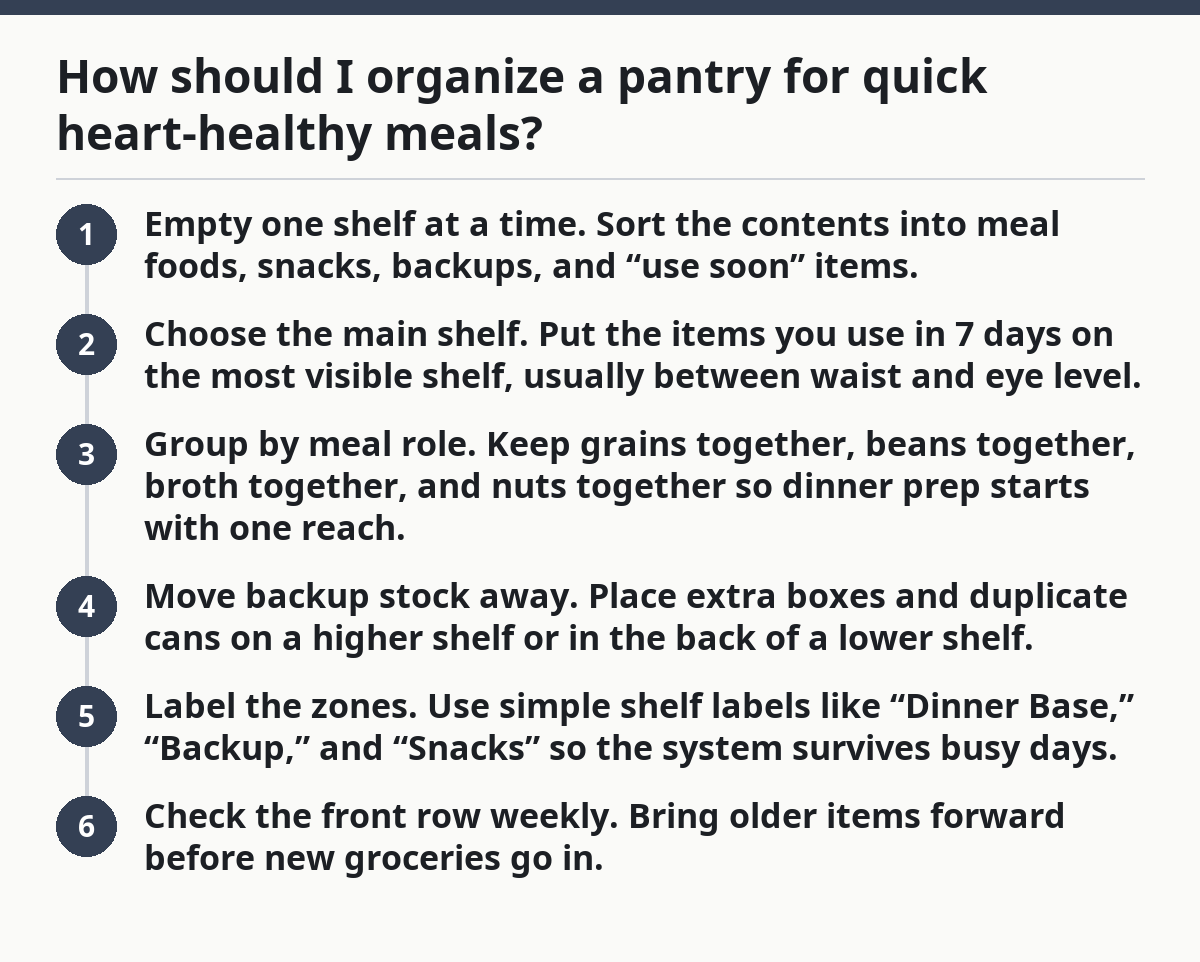
That layout works because it matches how dinner actually happens: one hand, one minute, one decision at a time.
What should go on each pantry shelf for easy cooking?
Each shelf should do one job. Picture a pantry where you can point to a shelf and know what belongs there. That keeps the search short and the cooking fast, especially on nights when you do not want to pull out five containers just to make soup.
A good shelf plan uses three to five zones, depending on the size of the pantry. If you have a narrow pantry, you may only get two shelves and a door rack. That is fine. The goal is not symmetry. The goal is reach.
Top shelf
Keep backup stock here: extra whole grains, unopened canned beans, backup broth, and anything you buy in duplicates. Put lighter items up top so nothing heavy has to be lifted over your head.
Middle shelf
This is the active dinner shelf. Put the foods you use most in the next few meals here: oats, brown rice, quinoa, canned beans, low-sodium broth, tomatoes, and nuts in a clear bin. If you cook from the pantry on weeknights, this shelf should be the easiest one to scan.
Lower shelf
Use this for heavier items and larger containers. Broth cartons, multipacks of canned beans, and bulk grains fit here well. If a shelf is deep, keep only one row in front and store extras behind a clear divider.
Door or narrow side rack
Use this for light, fast-grab items only. Labels, clip bags, spice jars, or single-serve snack packs can live here if the door closes without bumping them.
A label on every shelf is worth the 2 minutes it takes to make. Without labels, every shelf starts to look like storage instead of a plan. That is where the speed disappears.
- Middle shelf = active cooking foods
- Lower shelf = heavy backups
- Top shelf = overflow
- Door = small, light items only
How do bins and labels make a pantry faster?
Bins and labels make the pantry legible at a glance. Picture yourself with wet hands and a skillet on the stove. A clear bin tells you where the beans are before you read every package. A label keeps the bin from becoming a mystery drawer.
Use clear bins for foods you want to see in one look. Put one bin for whole grains, one for canned beans, one for broth packets or cartons if they fit, and one for nuts and seeds. If a bin is too full to lift easily, it is too full. Leave room so you can see the front item without digging.
Choose labels that name the job, not just the food. “Dinner Base” works better than “Misc.” because it tells you what belongs there. A label maker is nice, but masking tape and a marker work fine. If your pantry has low light, use larger labels with dark print so you can read them in seconds.
The truth is, labels also help other people keep the system intact. A partner, teen, or roommate can put groceries away faster when the shelf name is obvious. That matters on busy weeks, because a good pantry is only useful if it stays organized after the first cleanup.
Avoid opaque bins for the main cooking shelf. They hide what you own. Avoid tiny bins for things you buy often. They force overflow and turn the shelf into clutter. A clear front edge is better than a pretty container.
- Use one bin per meal role
- Keep labels short
- Leave room to see the front item
- Match bin size to how fast you use the food
For pantry layout ideas that fit into a bigger kitchen plan, the hub page on Heart-Healthy Ingredient Shopping and Pantry Systems helps connect the pantry to the rest of the food routine.
How do you keep pantry staples from getting forgotten?
You keep pantry staples from getting forgotten by rotating them on purpose and checking one short list each week. Picture a shelf where the newest can lands in front and the older can stays visible. That tiny habit keeps food moving and cuts waste.
Use the first-in, first-out rule. When you buy more canned beans or broth, put the new item behind the older one. On the active shelf, move older items to the front before you unload groceries. That is the simplest rotation system, and it works even in a small pantry.
You also need an inventory habit that takes less than 5 minutes. Once a week, glance at the active shelf and note what is low: whole grains, beans, broth, or nuts. Keep the note on your phone or on a paper list inside the pantry door. The point is not perfect tracking. The point is not buying a third box of the same grain because the first two vanished behind pasta.
A common mistake is making the pantry look tidy but hard to use. Matching jars can look nice and still hide how much food remains. Another mistake is storing everything by category without a cooking plan. That leaves your rice on one shelf, your beans on another, and your broth where no one remembers it. Dinner gets slower, not faster.
If you want the system to hold up, do this instead:
- Keep one “use soon” spot at the front of the active shelf
- Check the shelf before grocery shopping
- Pull older items forward when you unpack
- Write down what you actually run out of in a week
The best pantry system is the one that survives ordinary life: late arrivals, tired nights, and grocery bags dumped on the counter.
Which mistakes slow down heart-healthy weeknight cooking?
The biggest mistakes are hiding the foods you use most, overstuffing the pantry, and organizing by appearance instead of by use. Picture a pantry that looks neat but makes dinner harder. That is not organization. That is storage with better lighting.
Overstuffed shelves waste time because nothing can be seen without moving three other items. If you cannot spot the front can of beans or the broth carton in 10 seconds, the shelf is too crowded. Pull extras out and move them to backup storage.
Another mistake is grouping by package size. A tall box of grains next to a tiny jar of seeds may look orderly, but it does not match dinner prep. Group by function instead. Put ingredients for grain bowls together, soup starters together, and snack items together.
A third mistake is using bins that are too deep. Deep bins swallow the item at the back. A shallow bin or a front-facing tray is better for active foods. Use the deeper bin only for backup stock, not for the foods you grab every day.
If your pantry is very small, do not try to fit every category on display. A small pantry needs fewer zones, not more. Keep one shelf for active cooking foods, one for backups, and one for snacks. That is enough.
- Too many items on one shelf = slower cooking
- Opaque bins = hidden food
- Category-only storage = poor retrieval
- Deep bins for daily items = forgotten staples
A simple weekly reset that keeps the system working
A weekly reset keeps the pantry useful without turning it into a project. Picture a Sunday night check that takes the length of one song. You are not reorganizing everything. You are just making sure the shelf still supports the way you cook.
Start with the active shelf. Move older cans and boxes to the front. Put new groceries behind them. Toss damaged packaging, wipe crumbs from the shelf, and straighten the bins so labels face out. If something keeps getting lost, move it closer to eye level or into a more specific bin.
Set a repeat reminder for the same day each week. A 10-minute reset is plenty for many homes. If the pantry is getting messy faster than that, the system is too complicated. Simplify it before you add more labels.
Keep the reset tied to shopping. Before you buy more whole grains, canned beans, broth, or nuts, look at what is already there. That stops duplicates and keeps the pantry from filling with forgotten backups. It also tells you what dinner can be built from before you ever start cooking.
The system works when the pantry answers one question fast: “What can I make tonight?” If the shelf can answer that in a glance, the setup is doing its job.
Key Takeaways
- Put the foods you use for dinner on the easiest shelf to reach.
- Group pantry shelves by meal role, not by random size or package type.
- Use clear bins and plain labels so whole grains, beans, broth, and nuts are easy to spot.
- Rotate older items to the front before new groceries go in.
- Keep the system simple enough that it still works on a tired weeknight.
How should I organize a pantry for quick heart-healthy meals?
Organize it around the meals you make most often, not around a perfect label system. Keep whole grains, canned beans, broth, and nuts together in the most visible part of the pantry, and move backup stock out of the way. That makes dinner faster because the shelf matches the way you cook.
What should go on each pantry shelf for easy cooking?
Put active cooking foods on the middle shelf, heavier backups on the lower shelf, and overflow on the top shelf. If you have a door rack, use it for light items only. This layout keeps the most useful foods at the easiest reach and cuts down on hunting.
How do I keep pantry staples from getting forgotten?
Use first-in, first-out rotation and a short weekly check. Move older items to the front, keep a small “use soon” spot, and note what is running low before shopping. Those habits keep pantry staples visible and reduce the chance that good food gets buried behind newer groceries.
Drafted with AI; not yet reviewed by a person.