Last updated: November 20, 2026
Quick Answer: Stock a small kitchen with 4 to 7 heart-healthy ingredients, store them in stackable containers, and keep the list tight enough that nothing gets buried or duplicated. In How to Stock Heart-Healthy Ingredients for a Small Kitchen, the goal is simple: buy a few multi-use staples, place them well, and keep the cabinet readable. This is information, not financial advice; for your own situation, talk with a qualified adviser. The steps below settle what to buy first, how to fit it, and what not to cram in.
Key Takeaways
- Keep cabinet space clear, avoid duplicate purchases, and leave room for weekly foods.
- Choose ingredients that do more than one job, then give each item a fixed place.
- Start with ingredients that can anchor multiple meals, then add flavor.
- Make the shelf easy to read in 10 seconds or less.
What a small-kitchen stock plan needs to do
A small-kitchen stock plan needs to keep cabinet space clear, cut duplicate purchases, and leave room for the foods you use every week. Picture this: you open one cabinet, and the same bag of rice is not hiding behind three half-used boxes of crackers. That is the goal.
This approach fits people who cook at home in a studio, apartment, dorm-style setup, or any kitchen with limited cabinet space and little room for extra bins. It assumes you already know the basics of a heart-healthy pattern: more beans, grains, nuts, fruit, vegetables, and unsaturated fats; less heavy reliance on salty processed foods. The stock plan is about storage and buying habits, not about changing your whole menu overnight.
It is not a fit for someone trying to solve a fresh-food shortage with shelf-stable groceries alone. That is a different job, and a different page owns it. If your kitchen has almost no storage at all, the answer is to keep the ingredient list short and buy in smaller amounts more often.
A strong setup usually centers on a few workhorse foods: oats, rice, olive oil, and spices. Those four can cover breakfast, sides, grain bowls, and flavor without requiring a deep pantry. Keep the list tight, and the rest gets easier.
How do you stock a heart-healthy small kitchen?
You stock it by choosing ingredients that do more than one job, then giving each item a fixed place. Picture this: you are standing at the counter with one sheet pan, one cabinet, and no spare shelf. The plan has to work in that space, not in a perfect pantry you do not have.
Here is the catch: “heart-healthy” does not mean “buy everything labeled healthy.” It means buying a small set of ingredients you can combine fast, with minimal waste. A stackable container is any bin or tub that uses vertical space well, so one item sits cleanly on top of another instead of spreading across the shelf.
- Start with 5 to 7 staples. Pick foods you can use in more than one meal: oats, rice, olive oil, a few spices, canned beans if your storage allows, and one nut or seed. Verify that each item appears in at least 2 meals you actually make. If a food only serves one recipe, it may not be the best use of limited space.
- Assign one container per category. Use clear, stackable containers for dry goods and keep the same size where possible. Verify that lids close without bulging and that containers fit a shelf height with a little clearance. If a container needs tilting or forcing, it will become dead space.
- Put the heaviest items low. Place rice, oats, and any bulk dry goods on the lower shelf or in the deepest cabinet. Verify that you can lift them out with one hand. If you must move three things to reach one bag, the setup is too crowded.
- Keep olive oil visible. Store it at eye level, not behind tall items. Verify that the bottle is easy to grab when cooking. If it is hidden, you will forget it and reach for less useful fats.
- Group spices by use, not by alphabet. Put the 4 to 8 spices you use most near the stove or beside the sheet pan. Verify that you can identify them without pulling every jar forward. If you need to rummage, you will stop using them.
- Use a single duplicate rule. Do not keep two open bags of the same grain or two partial spice jars. Verify that only one open package exists for each staple. If duplicates appear, the cabinet is already doing too much work.
- Leave one empty slot. Reserve a small space for a new item or a leftover container. Verify that the shelf still has breathing room after grocery day. If every inch is full, restocking will become a shuffle game.
A full cabinet is not the target here, because tight packing makes it harder to find and use what you bought. The better result is a cabinet that stays readable after a week of cooking. That means you can see the oats, reach the rice, and use the olive oil before it gets forgotten behind a row of jars.
What should I buy first if storage is tight?
Start with the ingredients that can anchor multiple meals, then add flavor. Picture this: you have room for one tote and one shelf, not a full pantry makeover. The smartest first move is to buy items that turn into breakfast, lunch, or dinner with almost no extra gear.
The first items are usually oats, rice, olive oil, and a small set of spices. Oats work for breakfast or baked mixes. Rice supports bowls, sides, and quick meals. Olive oil helps with roasting, sautéing, and dressing food. Spices keep plain staples from tasting flat.
A useful order looks like this:
-
One whole grain
Choose oats or rice first, depending on what you cook most. -
One unsaturated fat
Olive oil is the simplest fit for a small kitchen. -
Three to five spices
Start with the ones that match your usual cooking. -
One protein backup
If you have room, add beans or another shelf-stable protein. -
One container system
Buy storage only after you know what needs storing.
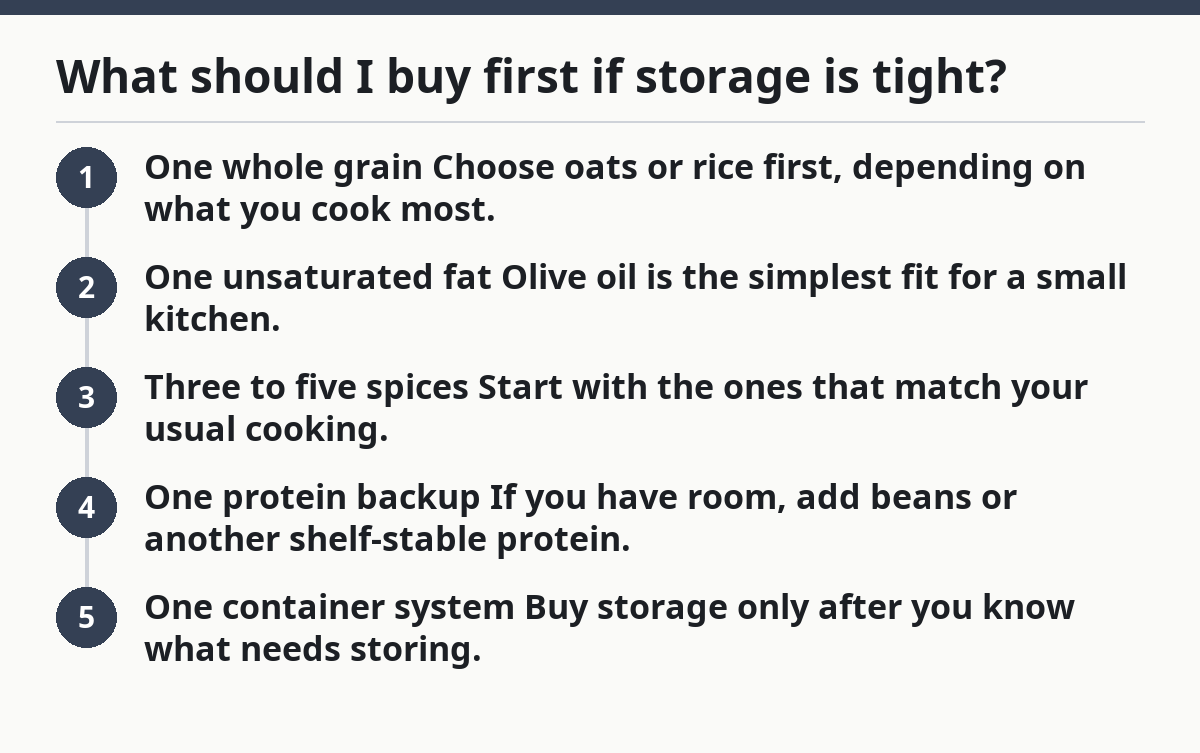
That order keeps you from buying pretty jars before you have a real plan. It also helps prevent duplicate purchases, because each item has a job before it takes up space.
On the flip side, skip specialty items that only work in one recipe unless you cook that recipe often. A jar used once a month is poor use of a tiny cabinet. The better fit is a narrow set of foods you know how to combine.
How do you store pantry staples in a tiny kitchen?
You store pantry staples by making the shelf easy to read in 10 seconds or less. Picture this: you open a cabinet and can spot the grain, the oil, and the spice jar without moving anything else. That speed is what keeps the system working.
Use the shelf like a little workstation. Put tall or heavy items at the back only if they still stay visible. Keep the front row for the things you use weekly. A sheet pan can also help here: store it vertically, if possible, so it does not eat shelf depth. That frees space for stackable containers underneath or beside it.
A simple layout often works best:
- Lower shelf: rice, oats, other heavy dry goods
- Eye level: olive oil and the most-used spices
- Top shelf: light, dry items you rarely reach for
- Door or narrow side space: flat packets, not bulky jars
You should also match storage to the food. Dry oats and rice do well in sealed containers. Spices stay fresher and easier to sort when they are grouped and protected from heat. Oil belongs where it will not get bumped or forgotten.
The mistake is turning every item into a display piece. Fancy jars look tidy until they consume half the shelf. Plain stackable containers usually work better because they use the cabinet shape instead of fighting it.
What mistakes waste space and money?
The biggest mistakes are buying too much variety, too much packaging, and too many one-use ingredients. Picture this: your cabinet is full, but dinner still feels complicated. That usually means the stock plan is working against the kitchen size.
Here are the errors I see most often:
-
Buying duplicate staples
The consequence is clutter and expired food. The fix is one open package per staple and a running list on the fridge or phone. -
Choosing oversized packages first
The consequence is storage pressure and awkward access. The fix is to buy sizes that match your actual shelf width and cooking pace. -
Storing everything in original boxes
The consequence is wasted air and hard-to-stack shapes. The fix is to move dry goods into stackable containers that fit the cabinet. -
Buying spice blends you rarely use
The consequence is a crowded shelf of half-used jars. The fix is to keep a small core set and add only what your meals need. -
Hiding olive oil or grains behind tall items
The consequence is forgotten food and repeat purchases. The fix is to keep the most-used items at the front or at eye level.
These mistakes do not look dramatic. They just make the kitchen slower and more annoying every week. Small kitchens punish wasted inches.
A good sign is that you can tell, at a glance, what needs replacing. If you cannot, the system is too dense.
When should you change the standard setup?
You should change the standard setup when the food you buy does not match the way you cook or the way your kitchen is built. Picture this: your cabinets are shallow, your counter is tiny, or you cook for one and do not go through bulk goods fast enough. The usual plan needs adjustment.
If you cook only a few times a week: big containers may work against you — use smaller amounts of oats, rice, and spices so food stays fresh and visible.
If your cabinets are deep and dark: items disappear in back — use clear bins or front-to-back organizers so the shelf acts like one layer, not a cave.
If you share the kitchen: duplicate purchases happen fast — label one zone for heart-healthy staples and agree on who refills what.
If you do not eat grains often: oats and rice may not earn their space — choose the staples you actually use, then keep the list short.
If you rely on a single small shelf: the usual “pantry” idea fails — use one container for each category and skip bulk buys that would crowd the shelf.
The truth is, a heart-healthy setup is not one fixed layout. It is a storage habit that keeps the right ingredients visible and the wrong ones from piling up. If the shelf stops making sense after two grocery trips, shrink the system.
What does a good result look like after a month?
A good result looks plain, not perfect. Picture this: one month later, you can make a meal without digging through boxes, and you are not repurchasing the same spice because the first jar vanished in the back.
The cabinet should hold a short list of ingredients you use often: oats, rice, olive oil, and a few spices, each with a clear place. The shelf should still have some open space. The containers should stack without wobbling. You should know, in one glance, what needs restocking.
A good setup also reduces friction at the stove. You reach for the same items again and again, so the kitchen feels smaller in a useful way. That is the point: fewer decisions, less clutter, and less waste.
If you still need a map to remember where everything lives, the system is too complicated. Trim it until it feels almost boring. Boring is good here.
For a broader ingredient system that fits this page’s approach, see the hub on Heart-Healthy Ingredient Shopping and Pantry Systems and the related guide on pantry organization basics.
In short: what belongs in a small heart-healthy kitchen?
A small heart-healthy kitchen should hold a short list of foods that pull double duty and fit in stackable containers. Picture this: oats, rice, olive oil, and a few spices doing most of the work while your shelves stay readable. That is a better system than a crowded cabinet full of one-off purchases.
The aim is not a perfect pantry. It is a cabinet that supports regular cooking without wasting space or money.
What heart-healthy ingredients fit in a small kitchen?
Heart-healthy ingredients that fit a small kitchen are the ones you can use in more than one meal and store in little space. Oats, rice, olive oil, and a few spices are the core examples here. If an ingredient only works in one recipe, it may not be the best use of limited cabinet space.
How do I store pantry staples in a tiny kitchen?
Store pantry staples in stackable containers, keep heavy items low, and put the most-used foods where you can see them fast. Use one area for grains, one for oil, and one for spices. If you have to move several items to reach one bag, the layout needs to be simpler.
What should I buy first if I have very little storage space?
Buy the ingredients that support the most meals first: one whole grain, one healthy fat, and a small set of spices. Oats, rice, olive oil, and a few seasonings cover a lot of cooking without filling the cabinet. Add more only after the first group has a fixed place.
Drafted with AI; not yet reviewed by a person.