Last updated: November 19, 2026
Quick Answer: compare two Nutrition Facts labels at the same serving size, then choose the lower sodium, higher fiber, and lower saturated fat option. For How to Compare Two Packages for Sodium, Fiber, and Saturated Fat, that is the fastest practical method without getting fooled by package size. The steps below show what to check, in what order, and what to ignore.
Key Takeaways
- Start with the Nutrition Facts label and rank sodium low, fiber high, and saturated fat low.
- Sodium is usually the first filter, but the food category can change the order.
- Use percent Daily Value as a quick screen, not the whole decision.
- Comparing by package instead of serving is the most common mistake.
Our Top 3 Picks at a Glance
-
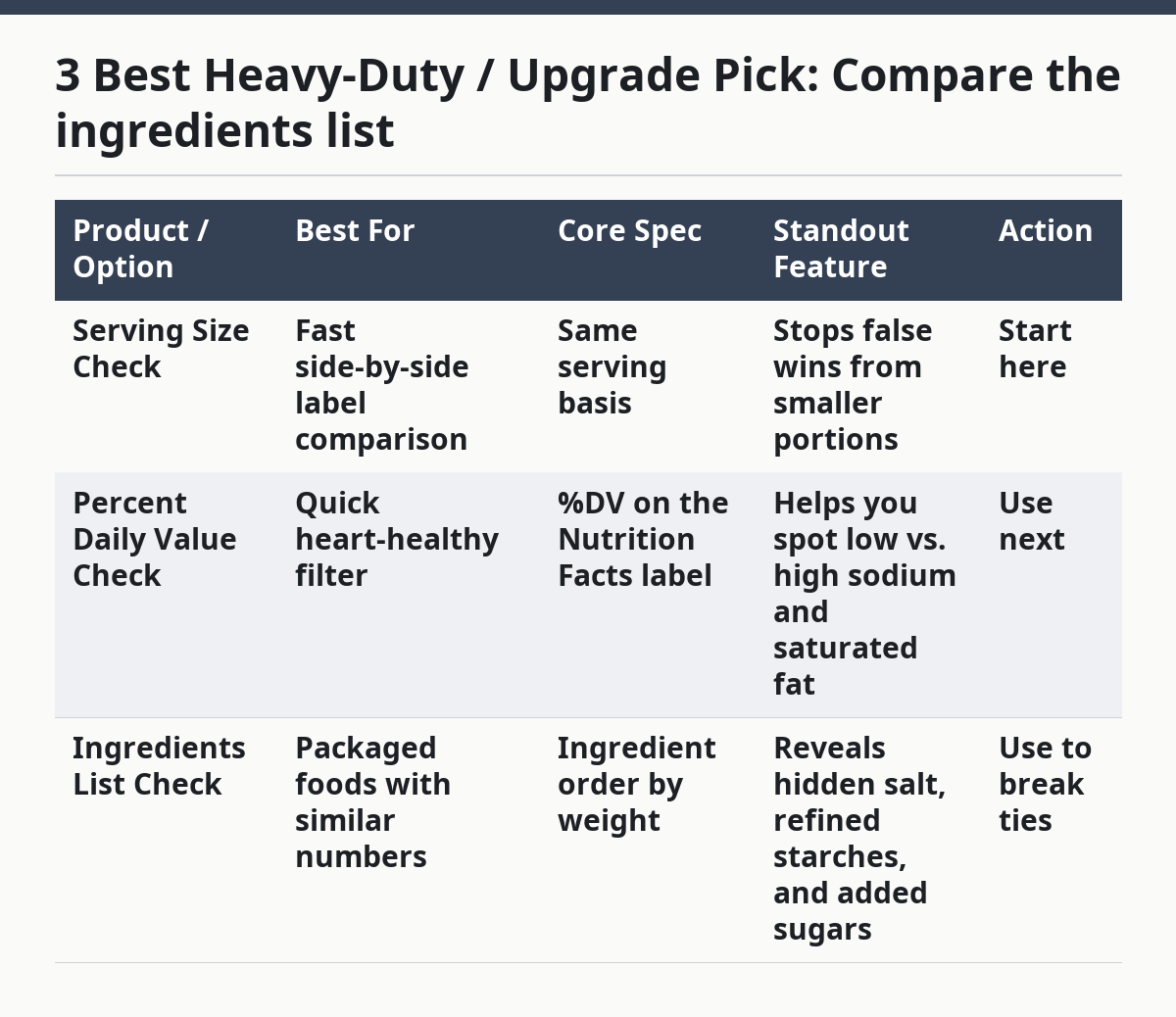
3 Best Heavy-Duty / Upgrade Pick: Compare the ingredients list
| Product / Option | Best For | Core Spec | Standout Feature | Action |
|---|---|---|---|---|
| Serving Size Check | Fast side-by-side label comparison | Same serving basis | Stops false wins from smaller portions | Start here |
| Percent Daily Value Check | Quick heart-healthy filter | %DV on the Nutrition Facts label | Helps you spot low vs. high sodium and saturated fat | Use next |
| Ingredients List Check | Packaged foods with similar numbers | Ingredient order by weight | Reveals hidden salt, refined starches, and added sugars | Use to break ties |
What should I compare first on two nutrition labels?
Compare the serving size first. If one box lists 1 cup and the other lists 1/2 cup, the numbers for sodium, fiber, and saturated fat are not equal until you line them up on the same amount.
You can compare two packages for sodium, fiber, and saturated fat only after the serving sizes match. A front label will not tell you that difference.
- Read the serving size on both Nutrition Facts labels.
- Match the amount if the serving sizes differ.
- Compare sodium, fiber, and saturated fat only after the amounts line up.
- Check servings per container so you know whether the whole package changes the picture.
A package with 140 mg of sodium per serving can still be a weak choice if the serving is tiny and the container has 4 servings. The same goes for fiber and saturated fat. A “good” number on a small serving can turn into a poor choice once you eat a real portion.
Here’s the catch: some packages are built to look better on paper. A cereal may list a 3/4-cup serving, while a competing box uses 1 cup. That difference matters more than a pretty front-of-box claim.
- Same serving size? Compare directly.
- Different serving size? Convert mentally or pick the package with the better numbers per the amount you actually eat.
- Multiple servings in the package? Multiply if you plan to eat more than one.
The FDA Nutrition Facts label uses serving size as the base for the numbers, so comparing two packages without this step is how people get fooled. That is the whole game.
How do I compare sodium, fiber, and saturated fat side by side?
Use the Nutrition Facts label, then score sodium low, fiber high, and saturated fat low. That gives you a clean comparison of heart-healthy packaged food without getting distracted by marketing claims on the front.
Both packages may say “whole grain” or “light” on the front, but the back label tells the real story. Sodium, fiber, and saturated fat are the three numbers that matter most for this comparison.
- Find sodium in milligrams.
- Find fiber in grams.
- Find saturated fat in grams.
- Compare each number at the same serving size.
- Choose the lower sodium, higher fiber, lower saturated fat option.
A simple rule helps:
- Sodium: lower is better.
- Fiber: higher is better.
- Saturated fat: lower is better.
The Food and Drug Administration uses Daily Values on labels to show how much a nutrient fits into a full day. For a quick label check, that helps you sort foods fast. A food with a lower %DV for sodium and saturated fat, and a higher fiber number, is usually the stronger choice.
On the other hand, do not treat one “good” number as a win by itself; the FDA and the American Heart Association both warn against relying on a single claim. A cracker can have decent fiber and still be packed with sodium. A yogurt can be low in sodium but high in saturated fat. One strong number does not cancel a bad one. If a product is borderline, consider asking a registered dietitian or other qualified health professional how it fits your needs.
Use this short logic test:
- If Package A has less sodium and less saturated fat, it already has an edge.
- If Package B has more fiber but far more sodium, that fiber may not be enough to win.
- If one package is close across all three, pick the one with the shorter ingredient list and fewer added sugars.
The biggest mistake is choosing a food because it has “more fiber” and ignoring the salt. A package can be high in fiber and still be a poor heart-healthy pick if sodium is high.
Which label number matters most for a heart-healthy comparison?
The number that matters most depends on the food, but sodium is usually the first filter. After that, fiber and saturated fat decide the better package.
You may be staring at two cans of soup, two frozen dinners, or two boxes of crackers and need a quick way to decide in under a minute. That is where the numbers on the label earn their keep.
Start with these three checks:
- Sodium: compare milligrams per serving.
- Fiber: compare grams per serving.
- Saturated fat: compare grams per serving.
If you want one shortcut, use this order:
- Lower sodium
- Higher fiber
- Lower saturated fat
That order works well because sodium tends to swing hard between brands, and many packaged foods hide a lot of it. Fiber helps make a grain or snack more filling, but it does not excuse a heavy salt load. Saturated fat matters most in foods like cheese, baked goods, frozen entrees, and snacks with oils or dairy.
The % Daily Value can help when two labels use different serving sizes or when the raw gram numbers are hard to scan. A lower %DV for sodium and saturated fat is usually the cleaner pick; a higher %DV for fiber is better.
Do not fall for these traps:
- Front-of-package health halos like “multigrain” or “made with whole grains.”
- Tiny serving sizes that make the numbers look better.
- “No cholesterol” claims that distract from sodium and saturated fat.
The best part is that, once you practice this on a few packages, the scan gets fast. In one aisle, you can tell which box is the better heart-healthy choice and move on.
How do I use percent Daily Value without getting lost?
Use percent Daily Value as a quick filter, not as the whole decision. It helps you compare sodium, fiber, and saturated fat fast when the label looks crowded.
You do not need to read every line like a tax form. % Daily Value gives you a short cut if you know the rough meaning of the numbers.
A simple guide on the FDA label is:
- 5% DV or less is low.
- 20% DV or more is high.
That rule helps for sodium and saturated fat. For fiber, you want the higher side. If one package gives you 20% DV fiber and the other gives you 8%, the first one is usually the stronger pick on fiber.
Use %DV like this:
- Lower %DV for sodium = better.
- Higher %DV for fiber = better.
- Lower %DV for saturated fat = better.
Here’s the catch: %DV only works well if the serving sizes are similar. If one package uses a much smaller serving, its %DV can look friendly while the actual amount you eat is not so friendly. Check the serving size before you trust the %DV.
A good habit is to compare two products side by side in this order:
- Serving size
- Sodium
- Fiber
- Saturated fat
- %DV as a shortcut check
One more note: labels can show added sugars too, and that number matters for overall food quality. This page is about sodium, fiber, and saturated fat, but if two products are tied, the one with lower added sugars often makes more sense for everyday use.
The U.S. Food and Drug Administration explains the label format, and the American Heart Association also publishes food-label guidance that lines up with this kind of comparison. Those are worth checking if you want the official reading rules.
What mistakes make two packages look better or worse than they are?
The most common mistake is comparing labels by the package, not by the serving. That mistake can make the worse food look better.
You may grab two pasta sauces and think the one with fewer milligrams of sodium is the winner. Then you notice that the “winner” has a much smaller serving size and more servings in the jar. The label did not lie, but your comparison did.
Common mistakes and what they cost:
- Ignoring serving size: you compare the wrong amount and pick the weaker food.
- Using the front label only: you miss sodium, saturated fat, or low fiber.
- Reading only one number: you may buy a high-fiber food that is also high in sodium.
- Forgetting servings per container: you may eat 2 servings and double the numbers.
- Trusting buzzwords: “whole grain” or “heart healthy” can hide a poor label.
Use this fix list:
- Match the serving size first.
- Compare all three numbers together.
- Check how many servings are in the package.
- Read the ingredients list if the numbers are close.
A package with 1 serving per container is easy. A box with 5 servings is where people get tripped up, because a snack eaten “just once” can turn into two or three servings without much thought.
The ingredients list can also expose the truth. If salt, cheese, cured meat, or a refined grain shows up early in the list, the label may be harder on your heart-healthy goals than the front claims suggest; if you have specific health concerns, a registered dietitian or other qualified professional can help interpret it. If two products are almost tied on the Nutrition Facts panel, the ingredients list can break the tie.
Do not use this rule for fresh produce or plain foods with no label. It is built for packaged food comparison, not for apples, eggs, or plain oats.
What should I check first on a label?
Check serving size first, then sodium, then fiber, then saturated fat. That order gives you the fastest clean comparison on packaged food.
You are at the store, and you have about 30 seconds before someone else reaches the shelf. You do not need to decode every line. You need a repeatable scan that works on cereals, soups, crackers, and frozen meals.
Use this order every time:
- Serving size
- Sodium
- Fiber
- Saturated fat
- Ingredients list
- Added sugars
If the serving sizes are different, fix that before anything else. If the sodium is close, let fiber and saturated fat decide. If those are close too, look at the ingredients list and added sugars.
A short ingredient list does not always mean “healthy,” but it can tell you a lot. If the first few ingredients are refined flour, salt, and sugar, the food is probably not the better heart-healthy pick. If whole grains appear early and sodium stays modest, that is a better sign.
This approach keeps the comparison focused on the label instead of the packaging. You do not need to hunt for perfection. You need the better package for the same use, whether that is bread, soup, cereal, or a snack.
For a broader walkthrough of label reading in heart-healthy grocery shopping, the hub guide can sit above this page as the next stop. This page stays focused on the side-by-side comparison itself.
Compare two packages in 30 seconds
You can compare two packages in 30 seconds by checking the same serving size and then reading sodium, fiber, and saturated fat in that order. That is the simplest usable method.
You have two foods in hand and want a fast answer before you keep shopping. You do not need a spreadsheet. You need one clean pass down the label.
Use this 30-second sequence:
- Match the serving size.
- Pick the lower sodium number.
- Pick the higher fiber number.
- Pick the lower saturated fat number.
- Use the ingredients list if the scores are close.
If one product wins on two of the three nutrients, that is usually your answer. If the other wins on fiber but loses badly on sodium, it is probably not the better heart-healthy choice. If both are close, the ingredients list and added sugars help break the tie.
This method works because it keeps the decision tied to the label, not to the package design. Bright colors, claims about whole grains, and “light” branding can all distract you from the numbers that matter.
The truth is, side-by-side label comparison gets easier after a few repetitions. You stop reading every word. You scan the same fields in the same order, and the better package becomes obvious faster.
Which number matters most on a nutrition label?
Sodium is usually the first number I check, because it often swings the most between two packaged foods. After that, fiber and saturated fat tell you whether the food is a better everyday choice or just a slightly better version of a processed product.
How do you compare two packaged foods?
Start by matching the serving size, then compare sodium, fiber, and saturated fat on the Nutrition Facts label. If the numbers are close, use the ingredient list and % Daily Value to see which package is the better fit for a heart-healthy grocery cart.
What should I check first on a label?
Check the serving size first.
Drafted with AI; not yet reviewed by a person.