Last updated: November 20, 2026
Quick Answer: heart-healthy cooking can still taste rich, feel filling, and fit a real weeknight schedule. The Complete Guide to Heart-Healthy Cooking for Flavor and Satisfaction shows how to build meals around fiber, unsaturated fat, and bold seasonings while cutting back on sodium, saturated fat, and ultra-processed add-ons. The steps below show how to do that without making dinner feel like punishment.
Key Takeaways
- You do not need a saintly recipe.
- Build the plate from a plant, a protein, and a smart fat, then finish with acid and herbs.
- You do not need to add more salt first.
- The most useful method keeps texture intact and gives enough flavor that you want seconds later.
In short: heart-healthy food should still be dinner, not a chore.
What makes a meal heart-healthy without making it bland?
Picture this: you’re standing at the stove at 6:30 p.m., hungry, tired, and staring at chicken, beans, rice, and a half-used lemon. You do not need a saintly recipe. You need a few cooking moves that make a meal taste big while keeping the heart-risky parts in check.
A heart-healthy meal usually does three things at once: it keeps sodium lower, it uses more fiber-rich plants, and it swaps heavy fats for unsaturated fats like olive oil, nuts, seeds, avocado, and fish. That is the flavor formula, not a punishment list.
The American Heart Association recommends a pattern that favors vegetables, fruits, whole grains, legumes, fish, nuts, and healthy oils, while limiting sodium, sugar, and saturated fat. See the AHA’s advice on healthy eating and sodium: American Heart Association — Healthy Eating and American Heart Association — Sodium.
Here’s the catch: bland food usually comes from weak technique, not from healthy ingredients. If the food tastes flat, the fix is often acid, heat, browning, salt timing, or a better sauce.
- Flavor comes from layers.
- Satisfaction comes from fiber and protein.
- Heart-health comes from the overall pattern, not one magic ingredient.
Which ingredients should anchor the plate in heart-healthy cooking?
Picture this: you’re opening the fridge and building dinner from what you already have. The easiest heart-healthy plate starts with a plant, a protein, and a smart fat, then gets finished with acid and herbs.
Use these as your default building blocks:
- Vegetables: broccoli, peppers, greens, tomatoes, carrots, cauliflower, mushrooms
- Fruit: citrus, berries, apples, stone fruit
- Whole grains: oats, brown rice, farro, quinoa, whole-wheat pasta, barley
- Legumes: lentils, black beans, chickpeas, white beans
- Proteins: fish, skinless poultry, tofu, tempeh, plain Greek yogurt, eggs in moderation depending on the meal pattern
- Fats: extra-virgin olive oil, canola oil, nuts, seeds, avocado
The big move is this: choose foods that naturally bring texture and flavor, so you do not have to lean on salt-heavy shortcuts. A can of beans, for example, becomes a real meal when it meets garlic, onion, cumin, lemon, and olive oil.
Choose more often:
- Beans and lentils for fiber and body
- Fish like salmon, sardines, trout, and tuna for protein
- Whole grains instead of refined starches
- Unsalted or lightly salted nuts and seeds
- Fresh herbs like basil, parsley, dill, cilantro, mint, rosemary, thyme
Use less often:
- Processed meats
- Cream-heavy sauces
- Butter-heavy finishes
- Packaged meals with long ingredient lists and high sodium
- Snack foods pretending to be dinner
The truth is, the ingredient list decides most of the battle before the pan even heats up. A pantry built this way also makes weekday cooking faster, because the base ingredients already work together.
How do you build flavor with less salt in heart-healthy cooking?
Picture this: you’re tasting a soup that seems fine but somehow still feels dull. You do not need to add more salt first. You need acid, aromatics, browning, and maybe a little heat.
Salt matters, but it should not carry the whole meal. In heart-healthy cooking, flavor usually gets stronger when you use four tools well: aromatics, acid, browning, and herbs/spices.
Aromatics are the base: onion, garlic, scallion, celery, fennel, ginger, and leeks. Cook them in a little olive oil until they soften and smell sweet. That first minute of smell is not decoration; it is the meal waking up.
Acid is the bright edge: lemon juice, lime juice, vinegar, tomatoes, yogurt, or pickled vegetables. Acid makes foods taste more complete, especially beans, greens, grains, and roasted vegetables.
Browning builds depth. Roast vegetables at high heat, sear mushrooms until they darken, toast spices in a dry pan, or brown turkey, chicken, or tofu before adding liquid. That browned surface gives you the savory note many people think only salt can provide.
- Use acid at the end.
- Toast spices early.
- Brown the food, not just the pan.
- Finish with fresh herbs.
For sodium, the CDC and the National Heart, Lung, and Blood Institute both stress that most sodium comes from packaged and restaurant foods, not the salt shaker. See the CDC’s sodium guidance: CDC — Sodium and NHLBI’s healthy eating pages: NHLBI — Aim for a Healthy Weight / DASH-style eating resources.
Now, you might be wondering how food can taste complete with less salt. The answer is balance. A dish with enough acid, enough fat, enough browning, and enough texture usually needs less salt than you think. In practice, that often means one bright ingredient, one browned ingredient, and one fresh finish.
The cooking methods that make healthy food feel satisfying
Picture this: you’re choosing between boiling, baking, roasting, sautéing, and steaming. The most effective method is the one that keeps texture intact and creates enough flavor that you actually want seconds later.
Roasting is the easiest satisfaction booster. It concentrates sweetness in vegetables and adds crisp edges. Brussels sprouts, carrots, cauliflower, broccoli, potatoes, squash, and tomatoes all get better when they meet a hot oven and a little oil.
Sautéing works when you want fast flavor. Use a moderate amount of olive oil, keep the heat high enough to build color, and avoid crowding the pan. Crowded food steams; spaced food browns.
Simmering is great for beans, soups, and stews. The trick is to build a base first, then let the food cook gently so the flavors blend without turning mushy.
Grilling and broiling add char, but they need care. Use them for fish, vegetables, chicken, or tofu, and pull the food before it dries out. Char is flavor in small doses, not a license to burn dinner.
- Roast for sweetness.
- Sauté for speed.
- Simmer for depth.
- Broil for quick browning.
One practical rule: if a healthy meal feels “too light,” the problem is often texture. A bowl of soft food can be filling, but a bowl with crunch, creaminess, and chew usually satisfies faster and longer.
How do you keep heart-healthy meals filling enough?
Picture this: you’re halfway through dinner and still thinking about snacks. The fix is usually not more bread. It is more protein, fiber, and volume from plants with enough fat to slow things down.
Fiber helps meals stick. Beans, lentils, whole grains, vegetables, fruit, nuts, and seeds all add bulk without making the plate feel heavy. Protein helps too, especially when you spread it through the meal instead of piling it into one tiny corner.
A practical plate often looks like this:
- Half vegetables or fruit
- A quarter protein
- A quarter whole grains or starchy vegetables
- A small amount of healthy fat
That pattern is simple, but it solves a real problem: people often quit heart-healthy eating because the food is “good for them” but not satisfying. This plate shape fixes that by giving the meal more texture and staying power.
A few filling combinations:
- Salmon, roasted broccoli, and brown rice
- Lentil soup with carrots, tomatoes, and whole-grain toast
- Chickpeas, cucumber, tomato, feta, herbs, and olive oil over farro
- Tofu stir-fry with peppers, snap peas, ginger, and brown rice
- Black bean tacos with cabbage slaw, avocado, and salsa
The best part is that these meals do not need to be perfect to work. A rough, real dinner eaten consistently beats a spotless plan that dies by Thursday. For example, one extra cup of vegetables can make the plate feel larger without changing the whole recipe.
What should a heart-healthy pantry actually include?
Picture this: you’re too tired to shop, so dinner has to come from the cupboard. A good pantry keeps heart-healthy cooking easy on the worst night of the week.
A practical pantry does not need a hundred items. It needs a short list of ingredients that can become soup, bowls, pasta, skillet meals, and tray bakes.
Keep these on hand:
- Extra-virgin olive oil
- Olive oil or canola oil
- Canned beans, rinsed
- Canned tomatoes, no-salt-added if possible
- Whole grains: oats, brown rice, quinoa, barley, whole-wheat pasta
- Nuts and seeds
- Broth with lower sodium
- Vinegar: red wine, apple cider, balsamic
- Spices: black pepper, cumin, paprika, chili powder, coriander, turmeric, cinnamon
- Alliums: onions, garlic, shallots
- Frozen vegetables and berries
Rinsing canned beans and vegetables under water can lower sodium from the canning liquid. It will not make a salty product perfect, but it can help a lot in a normal kitchen.
A short pantry also helps you avoid the “I have nothing to cook” trap. You do not need ten sauces. You need one oil, one acid, one spice mix, and a few sturdy foods that keep well.
- Oil gives body.
- Acid gives lift.
- Spices give identity.
- Beans and grains give the meal a spine.
What mistakes make heart-healthy cooking taste terrible?
Picture this: you’re following a healthy recipe and still ending up with food that feels dry, flat, or strange. The mistake is usually not the idea. It is one of a few repeatable habits that crush flavor.
The first mistake is over-restricting fat. Fat carries flavor. If you cut it too hard, food tastes thin and the mouthfeel drops off. You do not need a lot, but you do need some.
The second mistake is under-seasoning in layers. If you only salt at the end, the food can taste raw or disconnected. Season at more than one stage: the onions, the protein, the vegetables, and the final plate.
The third mistake is not using enough contrast. A bowl of soft beige food gets boring fast. Add crunch, acidity, or heat. Slaw on tacos, toasted seeds on soup, pickled onions on grain bowls, herbs on roasted vegetables — those details matter.
The fourth mistake is cooking everything too long. Overcooked vegetables lose flavor and texture. Fish dries out. Chicken gets stringy. A heart-healthy meal should still have life in it.
- Do not fear fat.
- Do not wait until the end to season everything.
- Do not serve one-note textures.
- Do not overcook the main protein.
Here’s the catch: a lot of people blame the recipe when the real issue is timing. A roasted vegetable that cooks 8 minutes too long is not “healthy” or “unhealthy.” It is just tired.
A simple before-and-after model for a weeknight dinner
Picture this: you’re trying to make one normal dinner better, not redesign your whole life. The clearest way to see the difference is to compare a common meal before and after a few smart changes.
| Metric | Before | After | Change | Timeline |
|---|---|---|---|---|
| Sodium source | Packaged sauce + salted sides | Herbs, acid, lower-sodium broth | Less reliance on packaged salt | Same meal |
| Fiber | White starch with few vegetables | Beans, whole grains, vegetables | More bulk and staying power | Same meal |
| Fat quality | Butter-heavy finish | Olive oil, nuts, avocado | Better fat profile | Same meal |
| Texture | Soft, one-note | Crunch, roast, chew | More satisfaction | Same meal |
| Flavor | Salt-forward | Layers of acid, spice, browning | Bigger taste with less salt | Same meal |
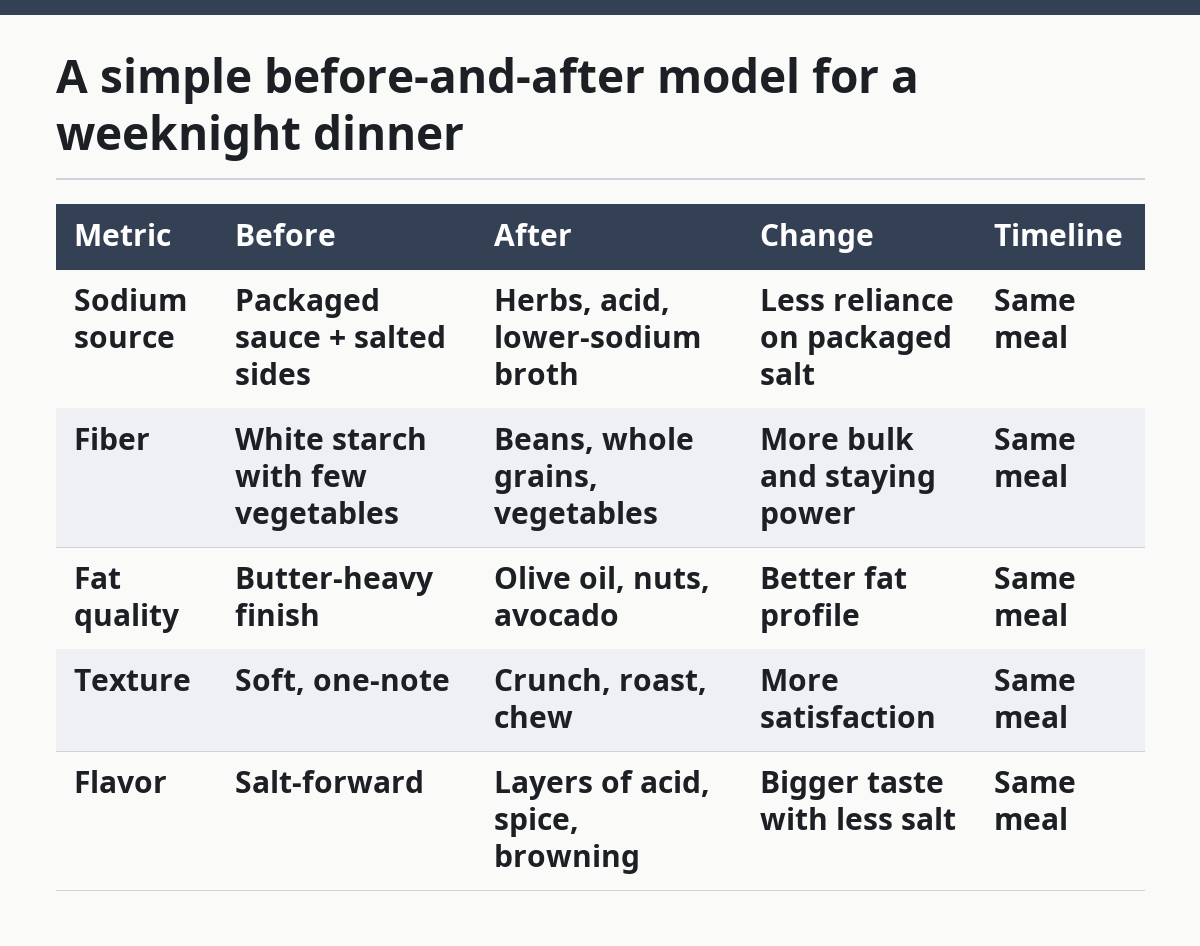
That model fits almost any dinner. You do not need a chef’s kitchen to use it. You need a better pattern.
A practical example:
- Start with brown rice instead of white rice.
- Add a can of rinsed black beans.
- Roast peppers and onions until they blister.
- Finish with lime juice, cilantro, and avocado.
- Add salsa for heat instead of a salty cream sauce.
The result tastes designed, not deprived. It also shows how one meal can change in five small steps instead of one big overhaul.
How does heart-healthy cooking work in real meals?
Picture this: you’re planning three dinners, not one fantasy recipe. Real life needs repeatable formulas, not a new idea every night.
These meal patterns work because they are flexible:
- Grain bowl: whole grain + bean or fish + roasted vegetables + sauce
- Sheet pan dinner: protein + vegetables + oil + spice + lemon
- Soup or stew: aromatics + legumes + vegetables + broth + herbs
- Stir-fry: lean protein or tofu + vegetables + ginger + garlic + rice
- Pasta night: whole-wheat pasta + tomato base + vegetables + olive oil + beans or fish
Keep the sauce simple. A yogurt-herb sauce, tahini-lemon sauce, salsa, chimichurri, or vinaigrette can carry the whole meal without much sodium.
If you cook for a family, build the base in a way that lets people customize the plate. One person wants extra heat. Another wants more crunch. Another wants more sauce. That flexibility helps the habit stick.
The truth is, heart-healthy cooking fails when it becomes a special project. It works when it looks like normal dinner with better defaults. It also works best when leftovers can become lunch the next day.
What about dining out, takeout, and busy nights?
Picture this: you’re not cooking tonight, and you still want the meal to fit the same heart-healthy pattern. The answer is to choose the least processed version of the thing you already want.
At restaurants, look for grilled, roasted, steamed, or braised dishes instead of fried ones. Ask for sauce on the side when possible. Choose vegetables, beans, or whole grains when they are available. Skip the biggest sodium traps: soups, creamy sauces, cured meats, and oversized portions; if you have a medical condition that affects sodium needs, ask a qualified professional for personal guidance and check trusted sources such as the CDC’s sodium guidance before making a big change.
For takeout, a few swaps help:
- Choose burrito bowls over burritos when you want less refined starch
- Pick tomato-based sauces over cream-based ones
- Order extra vegetables
- Split fries, chips, or dessert if you want them
- Add water or unsweetened tea instead of a sugar drink
A heart-healthy pattern does not require perfect control. It requires a better average over time.
One important caution: if you have a diagnosed heart condition, kidney disease, high blood pressure, diabetes, or any diet restriction from a clinician, get personal advice from a qualified professional. General guidance is useful, but individual needs can change the details.
FAQ
What is the easiest heart-healthy dinner to start with?
The easiest starting point is a bowl or plate built from one grain, one protein, and one vegetable. Brown rice, beans, and roasted broccoli is a good example, because it is cheap, filling, and easy to season with lemon, garlic, and olive oil. That structure works for many weeknights.
Can heart-healthy food still taste rich?
Yes, if you use the right fat and the right cooking method. Olive oil, nuts, avocado, and fish bring richness without relying on heavy cream or lots of butter. Roasting, browning, and finishing with acid make the food taste fuller.
Do I have to cut salt completely?
No, you do not have to cut salt completely. The better move is to use less sodium from packaged foods and let herbs, spices, acid, and browning do more work. If you have high blood pressure or another medical condition, ask a qualified clinician about your target sodium range.
Is frozen food okay for heart-healthy cooking?
Yes, frozen vegetables, fruit, and plain proteins can be excellent choices. They are often picked and frozen at good quality, and they help you cook faster. Check labels for added sauces, breading, or sodium when you buy them.
What should I cook if I want heart-healthy food that still feels satisfying?
Cook meals with fiber, protein, and texture. A salmon tray bake with vegetables, a lentil soup with whole-grain bread, or a bean-and-vegetable grain bowl all hit that mark. The meal should look like dinner, not a side dish pretending to be enough.
Drafted with AI; not yet reviewed by a person.