Last updated: November 20, 2026
Quick answer: Cook dry beans by soaking them, simmering them gently, and seasoning them without salt, then stash the cooked beans for bowls, soups, and salads all week. How to Cook Beans from Dry for Heart-Healthy Meals starts with a simple base: dry beans are cheaper than many ready-made options, and they give you a mild base you can season in a heart-healthy way. The same method works for black beans, chickpeas, lentils, and kidney beans, with small time changes.
Key takeaways
- Dry beans need water, time, and low heat; they do not need salt to taste good.
- Soaking often shortens cooking for many beans, and lentils often cook well without soaking.
- A bay leaf, onion, garlic, cumin, or pepper adds flavor without pushing salt to the center of the dish.
- Stovetop cooking gives you the most control; a pressure cooker cuts the wait.
- Cooked beans keep well in the fridge for about 4 days and freeze well for longer storage.
What should I buy first?
Buy dry beans that look whole, not cracked, and choose the type that fits the meal. Black beans work well in bowls and soups, chickpeas hold their shape in salads, lentils cook fast for weeknight meals, and kidney beans suit chili-style dishes.
A 1-pound bag is a common starting point, but even 1 cup of dry beans makes a useful batch. For a heart-healthy pantry, plain dry beans are the point: no seasoning packet, no salt blend, no sugary sauce. If you want to include allergen-friendly add-ins, keep in mind that onions and garlic are not common allergens, while soy sauce and some spice blends can contain wheat or soy.
The basic trade-off is simple. Bigger beans, such as chickpeas and kidney beans, often take longer than lentils. Smaller split lentils cook faster and break down more, so they work better in soups than in a bean salad. For a mixed-meal routine, stock 2 or 3 types and rotate them during the week.
How do I soak dry beans?
Soak dry beans by covering them with plenty of water and leaving them alone long enough to hydrate fully. The most common method is an overnight soak of about 8 to 12 hours, which helps many beans cook more evenly.
Use a large bowl or pot and cover the beans with at least 2 inches of water, which is about 5 cm. Beans swell a lot, so a small container gets crowded fast. After soaking, drain the water and rinse the beans before cooking. Lentils are the exception here: they often do not need a soak, and that saves time on a weeknight.
A quick-soak method also works when the clock is tight. Put the beans in a pot, cover them with water by 2 inches, bring them to a boil for 2 minutes, turn off the heat, and let them sit for 1 hour. That method is useful for black beans and kidney beans when you want dinner the same day. It is less useful for chickpeas, which still need a longer simmer after the soak.
How to cook beans from dry on the stovetop
Cook dry beans from dry on the stovetop by simmering them gently in fresh water until they turn tender. Start with a heavy pot, enough water to cover the beans by 2 inches, and low heat that keeps the liquid at a calm simmer, not a hard boil.
- Measure 1 cup of dry beans and sort out stones or shriveled pieces. This gives you a clean batch and a clear starting amount.
- Soak the beans in a bowl with 2 inches of water for 8 to 12 hours, then drain and rinse them. This often shortens the simmer and helps the beans cook more evenly.
- Transfer the beans to a pot and add fresh water to cover them by 2 inches, or about 5 cm. Fresh water keeps the cooking liquid cleaner and less starchy.
- Add a bay leaf, half an onion, or 2 smashed garlic cloves for flavor. These add aroma without salt, and the beans still stay plain enough for many dishes.
- Simmer the beans over low heat until tender, which often means about 45 to 90 minutes for soaked black beans or chickpeas, with lentils needing less time. Kidney beans need the same gentle simmer but usually take the longer end of that range.
- Check a bean near the end by pressing it between two fingers or tasting one bean. It should be tender through the center, not chalky.
- Drain the beans if you want them drier for salads, or keep some cooking liquid if you want them for soup. The liquid can help a pot of beans stay moist without adding fat or salt.
Keep the lid slightly ajar if the pot threatens to boil over, and add water as needed so the beans stay covered. A rolling boil can split skins and leave some beans soft outside and hard inside. That matters most for chickpeas and kidney beans, which need steady heat to hold shape.
One important safety note belongs here: dry kidney beans should be boiled hard for 10 minutes before they continue at a simmer. After that, reduce the heat and cook until tender. That step matters because kidney beans need stronger heat at the start than black beans or lentils. For extra guidance, the USDA FoodKeeper app and MyPlate both offer practical storage and food-group advice.
What changes with a pressure cooker?
A pressure cooker cooks dry beans faster, but it asks for more attention to water level and bean type. It is a strong option when you want a same-day batch without hovering over the stove for an hour.
Use the cooker according to its manual, because models differ. In general, soaked black beans and chickpeas finish much faster under pressure than on the stovetop, while lentils may cook so fast that they turn mushy if you are not careful. Kidney beans still need proper prep and full cooking before serving.
The main benefit is time. The main drawback is less visual control, because you cannot easily taste the beans as they soften. If you want firm beans for salads, stop early and let the pressure drop naturally when the manual says to do so. If you want beans for soup or mash, a softer texture is an advantage.
Salt is still optional, not required. Add bay leaves, onion, garlic, cumin, oregano, or black pepper before cooking, then season the finished beans at the table if needed. If you are aiming for heart-healthy meals, that keeps the bean pot useful across several dishes instead of locking it into one salty flavor.
How do I flavor beans without salt?
You flavor beans without salt by building taste with aromatics, spices, and the cooking liquid itself. A bay leaf, 1 chopped onion, 2 garlic cloves, or 1 teaspoon of cumin can do real work in a pot of beans.
This is where many generic bean recipes go wrong: they lean on salt to cover a flat pot. Beans need depth, not just salinity. Try black beans with garlic and cumin, chickpeas with bay leaf and onion, lentils with pepper and thyme, and kidney beans with onion and oregano. Those combinations work without a heavy hand, and they keep the beans useful for soups, salads, and grain bowls.
Acid should wait until the beans are tender. Tomato, vinegar, and citrus can slow softening if they go in early, so add them near the end or at the table. That is why a squeeze of lemon belongs at the table or in the finished soup, not in the first 10 minutes of the simmer.
If you want more body, mash a small portion of the cooked beans back into the pot. That makes the broth thicker without cream, flour, or extra salt. It works especially well with lentils and black beans.
How should I store cooked beans?
Store cooked beans in the fridge for about 4 days or freeze them for longer use. Cool them first, then move them into shallow containers so they stop steaming and do not sit warm too long.
For fridge storage, keep the beans with a little cooking liquid if you want them to stay moist. For freezer storage, portion them into containers or bags in the amount you are likely to use later, such as 1 or 2 cups. That makes them easier to drop into soups, salads, and quick meals.
The main trade-off is texture. Beans stored in liquid stay softer, which is great for soup but less ideal for salads. Beans stored with less liquid keep their shape better, but they can dry out if you do not add a spoonful of broth or water when reheating. Reheat until steaming hot before serving.
For a larger heart-healthy routine, this method pairs well with the broader heart-healthy cooking methods hub. The point is to keep a cooked bean ready so dinner starts with a useful base instead of a can or a packet.
Which bean should I choose for my meal?
Choose the bean that matches the texture you want and the time you have. Black beans and kidney beans suit hearty dishes, chickpeas hold shape for salads, and lentils are often the fastest choice for a quick pot of soup.
| Bean type | Best use | Soak needed? | Typical cook style |
|---|---|---|---|
| Black beans | Bowls, soups, mash | Yes, usually | Stovetop or pressure cooker |
| Chickpeas | Salads, stews, hummus-style dishes | Yes, usually | Stovetop or pressure cooker |
| Lentils | Soups, sides, fast meals | No | Stovetop simmer |
| Kidney beans | Chili-style dishes, soups | Yes, usually | Stovetop or pressure cooker |
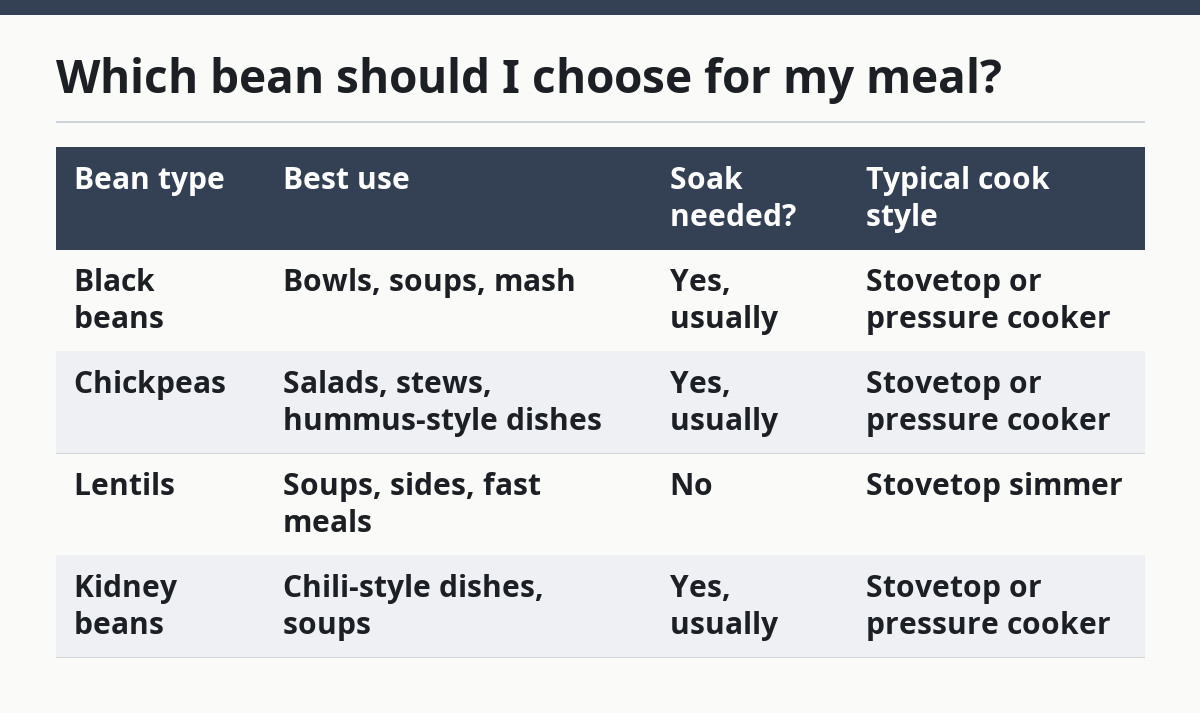
This choice matters for heart-healthy meals because it helps you keep the dish built around beans instead of meat or cream. It also cuts waste: if you know chickpeas take more time, you can plan them for a weekend batch. If you need dinner in under an hour, lentils are the better fit.
Do you have to soak beans before cooking?
No, you do not always have to soak beans before cooking, but soaking usually makes the process more even and predictable. Black beans, chickpeas, and kidney beans often benefit from an 8 to 12 hour soak, while lentils usually do not need one at all.
A soak can also shorten stovetop time and help some beans cook more evenly. If you are short on time, a quick soak of 1 hour after a 2-minute boil is a workable shortcut for many dry beans.
How long do dry beans take to cook?
Dry beans can take from under 30 minutes to about 90 minutes or more, depending on the type and whether you soaked them.
Soaked beans cook faster and more evenly on the stovetop. A pressure cooker can shorten the wait, but the exact time depends on the model, the bean type, and how soft you want them to be. For a tested reference, the USDA FoodData Central database and the Harvard T.H. Chan School of Public Health both note beans and legumes as nutrient-dense foods that fit a balanced eating pattern.
How do you flavor beans without salt?
Flavor beans without salt by using bay leaves, onion, garlic, cumin, oregano, and black pepper. Add those during cooking for a built-in base, then finish with lemon juice or vinegar after the beans are tender.
If the pot still tastes flat, mash a few beans into the liquid. That adds thickness and flavor without turning the dish salty.
Drafted with AI; not yet reviewed by a person.