Last updated: November 20, 2026
Quick Answer: 3 simple parts are enough for How to Make Heart-Healthy Breakfasts with No Kitchen Appliances: one fiber food, one protein food, and one fruit.
In short: Build breakfast from whole grain bread, oats, fruit, yogurt, nuts, and peanut butter, then pair one fiber food with one protein food and one fruit.
This page shows the exact no-appliance breakfast moves that work in a hotel room, dorm, or office morning.
It also clears up the common traps that make a cold breakfast feel thin, boring, or too salty.
A heart-healthy breakfast with no kitchen appliances is built from foods you can open, spread, stir, and eat cold. The goal is not cooking — it is balance. In How to Make Heart-Healthy Breakfasts with No Kitchen Appliances, the fastest path is a 3-part meal.
Key Takeaways
- Start with one fiber base, such as whole grain bread or oats.
- Add one protein food, such as yogurt, peanut butter, or nuts.
- Finish with fruit for flavor, volume, and a cleaner plate.
- Keep sodium low by skipping salty breakfast meats and heavy packaged pastries.
- Use only shelf-stable or refrigerator-safe foods that match your room setup.
- A good no-appliance breakfast is fast, but it still needs structure.
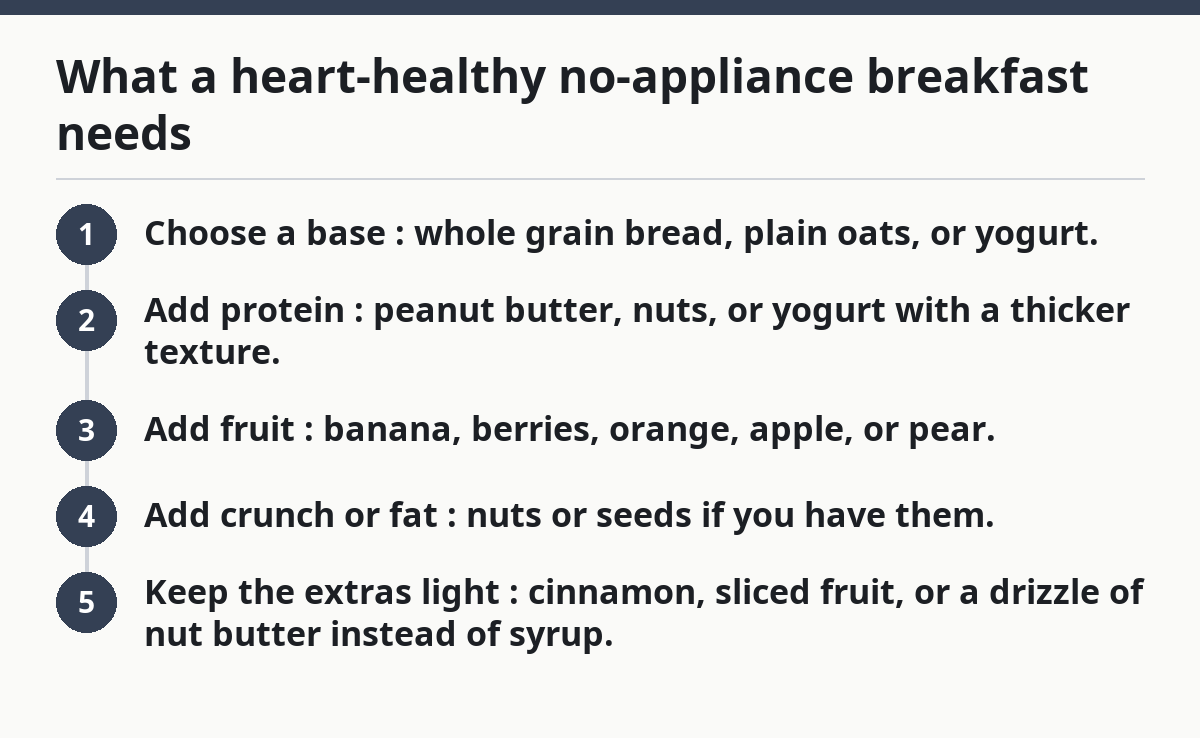
What a heart-healthy no-appliance breakfast needs
Because a cold breakfast has to work without heat, it needs structure from the start. Picture this: you’re standing in a hotel room with a paper cup, a spoon, and a grocery bag on the bed, trying to make breakfast that will actually hold you through the morning. You don’t need a stove, toaster, or blender — you need fiber, protein, and unsaturated fat in the same meal.
Here’s the catch: a cold breakfast can go wrong fast if it is just fruit or just bread. That leaves you hungry again by 10 a.m., and it usually pushes you toward pastries or chips later. The fix is simple: build the plate in layers.
- Choose a base: whole grain bread, plain oats, or yogurt.
- Add protein: peanut butter, nuts, or yogurt with a thicker texture.
- Add fruit: banana, berries, orange, apple, or pear.
- Add crunch or fat: nuts or seeds if you have them.
- Keep the extras light: cinnamon, sliced fruit, or a drizzle of nut butter instead of syrup.
Most of these foods need only a knife, spoon, napkin, and a bowl or cup. This matters because the setup stays simple. The meal still feels complete.
A good rule is to think in pairs, not in single items. Whole grain bread without a topping feels incomplete. Peanut butter alone can feel heavy. Fruit alone fades quickly. Put them together and the meal starts to make sense.
The simplest formula
- Base: 1 slice whole grain bread, 1 small bowl of oats, or 1 cup yogurt
- Protein/fat: 1 to 2 tablespoons peanut butter, a handful of nuts, or a serving of yogurt
- Produce: 1 piece of fruit or 1 cup berries
- Optional finish: cinnamon, chia, or a second slice of bread
A plain apple, a spoonful of peanut butter, and a slice of whole grain bread is not fancy. It is practical for a room with no appliances, and it keeps breakfast simple.
How to make a no-appliance breakfast in 3 steps
Because the ingredients are already ready to eat, the method is mostly assembly. Picture this: you’re in a dorm room or hotel room with only a mini-fridge and a small counter, and you need breakfast that takes less than 10 minutes. The answer is to assemble a cold meal in 3 steps so you don’t overthink it.
- Pick one grain or dairy base. Choose whole grain bread, plain oats, or yogurt. Whole grain bread gives a chew and holds toppings well; oats and yogurt give a softer start.
- Add one solid protein. Spread peanut butter on bread, stir nuts into oats, or eat a yogurt cup with a handful of nuts on the side. This is the part that keeps the meal from feeling flimsy.
- Add fruit last. Slice a banana over oats, eat berries beside yogurt, or pack an apple with peanut butter. Fruit brings volume and sweetness without turning the meal into dessert.
On the flip side, don’t stack every ingredient into one bowl if the texture gets muddy. A crisp apple beside peanut butter is often better than chopped fruit drowned in yogurt. Texture matters, and the meal stays easier to eat when each part keeps its shape.
A few clean combinations that work
- Whole grain bread + peanut butter + banana
- Plain yogurt + berries + nuts
- Oats + chopped apple + peanut butter
- Whole grain bread + yogurt on the side + orange
- Oats + nuts + sliced pear
If you need a label for the method, this is assembly only cooking. The food is still deliberate; it just doesn’t need heat.
How to use peanut butter, yogurt, oats, nuts, fruit, and whole grain bread
Because the core foods do different jobs, the easiest way to use them is to assign each one a role. Picture this: you’re staring at six groceries and want the best use of each one without making a mess. The answer is to give each food a job — bread holds, yogurt cools, oats bulk up, nuts add crunch, fruit brightens, and peanut butter binds.
Whole grain bread is the easiest place to start because it gives you a sturdy base and a familiar bite. Peanut butter works well on bread or with fruit because it adds fat and protein in one spoonful. Plain yogurt is useful when you need something cold and quick, but it becomes much better with fruit and nuts on top.
Oats work only if you choose a form you can eat without heat. Some people use plain oats with yogurt or milk in a bowl and let them sit while they get dressed. Others keep oats dry and mix them into yogurt for texture. Nuts are the easiest add-on: a small handful changes the meal without much prep.
Fruit should do more than decorate the plate. Bananas, apples, oranges, berries, and pears all behave differently, so pick the one that matches your setup. Bananas are easiest when you have no knife. Apples and pears travel well. Berries are best if you have a fridge.
Match the food to the setting
- Hotel room: yogurt cups, bananas, whole grain bread, single-serve nuts
- Dorm room: oats, peanut butter, apples, shelf-stable fruit, bread
- Office morning: nuts, fruit, sealed yogurt, whole grain toast from home
- No fridge at all: bread, peanut butter, apples, oranges, dry oats in a cup
The truth is, the ingredients matter less than the mix. You want something chewy, something creamy, and something fresh. That trio is what makes a cold breakfast feel like a meal instead of a snack.
Cold breakfast ideas for a hotel room or dorm
Because a hotel room or dorm room often has little more than a fridge, the safest plan is a cold breakfast. Picture this: you’re packing for a night away and the room has no toaster, no microwave, and no stove. The answer is to plan a cold breakfast before you arrive so you can eat without hunting for room service or vending machines.
A hotel room is easiest when you can stop at a grocery store or bring a small bag from home. Look for plain yogurt, bananas, apples, whole grain bread, peanut butter, and a small container of nuts. A dorm room works the same way, except storage matters more, so shelf-stable items help when the fridge is crowded or tiny.
Here are three strong cold-breakfast builds:
- Hotel plate: plain yogurt, berries, and nuts, plus a slice of whole grain bread with peanut butter.
- Dorm bowl: oats mixed with yogurt and topped with banana slices and nuts.
- Portable combo: apple, peanut butter, and whole grain bread for a breakfast you can eat on the way to class.
The common mistake is buying only fruit because it feels light. Fruit is good, but fruit alone often leaves you searching for food again soon. Add bread, oats, yogurt, peanut butter, or nuts and the meal holds better.
A second mistake is reaching for packaged breakfast pastries because they are easy. They are easy, yes, but they are usually a poor trade for a heart-healthy morning. A plain bagel with peanut butter and fruit beats a frosted pastry every time.
Make it work with almost no tools
- Use a napkin and spoon if you don’t have a full set of utensils.
- Choose single-serve yogurt if storage is tight.
- Keep peanut butter packets or a small jar in the room if allowed.
- Buy prewashed fruit when you want less cleanup.
For people staying in a hotel, the room fridge becomes your best friend. For people in a dorm, shelf-stable food does most of the work. Different setting, same logic.
What to avoid if you want breakfast to help your heart
Because convenience can push you toward the wrong foods, it helps to sort the choices before you buy them. Picture this: you’re trying to eat better, but the easiest breakfast choices are salty, sugary, or too light to matter. The answer is to skip the foods that look convenient but work against a heart-healthy pattern.
The biggest trap is processed breakfast food. Sugary pastries, frosted bars, and salty meat-heavy items do not belong in the same lane as whole grain bread, fruit, and nuts. They may fill the gap for a moment, but they don’t give the same steady feel.
A second trap is turning every breakfast into a sugar bowl. Fruit is healthy, but fruit plus sweet yogurt plus syrup plus sweet granola can become dessert fast. Keep the base plain, then add one sweet item that tastes good enough on its own.
A third trap is ignoring portion size on calorie-dense foods. Peanut butter and nuts are useful, but they are dense. A spoonful or small handful goes a long way. More can crowd out the rest of the meal.
Better swaps
- Swap frosted pastries for whole grain bread + peanut butter
- Swap flavored yogurt for plain yogurt + fruit
- Swap candy-like granola for nuts
- Swap juice-heavy breakfasts for whole fruit
If a breakfast has no fiber and no protein, it usually fails by midmorning. That is the cost. The fix is to add one of each, even if the meal stays simple.
A 2-minute shopping list for a week of no-appliance breakfasts
Because the same foods can carry several breakfasts, the shopping list does not need to be long. Picture this: you’re at the store, tired, and trying to buy breakfast food that won’t go bad before Friday. The answer is to keep the list short and repeat the same building blocks across the week.
Start with one grain, two proteins, and two fruits. That gives you enough mix without cluttering the fridge or cabinet. For many people, the cleanest setup is whole grain bread, plain oats, peanut butter, plain yogurt, nuts, bananas, and apples.
If you want a weekly pattern, this is easy to repeat:
- Monday: whole grain bread, peanut butter, banana
- Tuesday: yogurt, nuts, berries
- Wednesday: oats, apple, peanut butter
- Thursday: bread, yogurt, orange
- Friday: oats, nuts, banana
That kind of repetition is not boring if the texture changes. Bread one day, bowl the next, fruit on the side the next. The meal stays familiar without feeling identical.
For a practical shopping rule, buy what you can eat in 3 to 5 days if you have little storage. Buy shelf-stable foods for the items you want to keep longer. That keeps waste down and makes the plan easier to stick with.
This page fits the larger Heart-Healthy Breakfast Planning and Morning Routines hub, which handles the bigger pattern around mornings, not just the no-appliance case.
A simple cart
- Whole grain bread
- Peanut butter
- Plain yogurt
- Oats
- Nuts
- Bananas
- Apples or oranges
The best cart is the one you can actually use on a sleepy weekday morning. Fancy doesn’t help. Repeatable does.
What can I eat for breakfast without a stove or microwave?
You can eat whole grain bread with peanut butter, plain yogurt with fruit and nuts, or oats mixed cold with yogurt or milk. Those three builds cover most no-appliance mornings because they give you fiber, protein, and fruit without heat. If you only have a knife and spoon, start there.
How do I make a heart-healthy breakfast in a hotel room?
You make a heart-healthy breakfast in a hotel room by using the mini-fridge, a grocery run, and simple assembly. Buy plain yogurt, fruit, whole grain bread, peanut butter, and nuts, then combine one grain, one protein, and one fruit. Skip pastries and sweet drinks if you want the meal to hold you longer.
What no-cook breakfast options are filling?
The filling no-cook options are the ones with fiber plus protein, not just fruit or bread alone. Plain yogurt with nuts and berries, whole grain bread with peanut butter and banana, and oats mixed with yogurt all work well. Those combinations tend to feel steadier than single-item breakfasts.
Drafted with AI; not yet reviewed by a person.