Last updated: November 19, 2026
Quick Answer: a one-protein week usually works best when you plan for 4 dinners plus 1 or 2 lunches. A week of heart-healthy meals gets easier when you choose one main protein and build the rest of the plate around it in How to Plan Heart-Healthy Meals Around a Single Main Protein for the Week.
The fix is simple: batch the protein, split it into portions, and pair each serving with different vegetables, grains, and sauces.
The steps below show how to keep the week varied without starting from scratch every night.
Key Takeaways
- Pick one protein anchor for 3 to 4 meals, then switch the sides and seasonings.
- Cook once, portion fast, and keep each meal on a different plate pattern so it doesn’t feel repetitive.
- Use the same protein in bowls, wraps, salads, soups, and breakfast-style meals.
- Keep salt, heavy cream, and fried add-ons low; use acid, herbs, and texture instead.
- Rotate in fish, beans, tofu, eggs, and Greek yogurt across the month so one food does not have to do every job.
What does a one-protein week actually look like?
A one-protein week means choosing one anchor—like chicken, salmon, tofu, beans, Greek yogurt, or eggs—and planning 3 to 5 meals around it before you shop.
That anchor does not stay naked on the plate; it gets different sides, shapes, and sauces so Monday dinner doesn’t taste like Thursday lunch.
This is the cleanest way to avoid decision fatigue.
Since the goal is variety, the plan has to start before you open the fridge. Picture a Sunday kitchen with a cutting board, a sheet pan, and a notebook. You do not need a gourmet plan. You need one protein, two or three vegetables, one starch, and a few flavor moves that change the week without changing the grocery list.
The truth is, most people fail here because they plan meals one by one. That leads to half-used herbs, extra produce, and a fridge full of pieces that don’t fit together. A single-protein plan solves that by giving the week one backbone.
Start by choosing the protein and the number of meals it needs to cover. For many households, that means 4 dinners plus 1 or 2 lunches. If you need more than that, split the load: use chicken for the first half of the week and beans or eggs for the second half.
That choice matters more than fancy recipes, because the plan only works if it matches your schedule.
It really does.
How do you plan the week around one main protein?
You plan the week around one main protein by mapping the cooking day, the portion count, the side dishes, and the backup meal before you shop.
This keeps the protein from sitting in the fridge while you wonder what to do with it.
Because the structure is simple, the week feels simpler too. Write the plan on the back of an envelope, and give each day a label—bowl, salad, wrap, skillet, soup. That small move stops the week from turning into leftovers on repeat.
-
Choose one protein with a clear use case, such as chicken thighs for bowls, salmon for quick dinners, tofu for stir-fries, or beans for soups.
Keep the plan to one anchor so the shopping list stays tight. -
Count the portions you need, then divide the protein before cooking.
If dinner and lunch both matter, portion the batch into meal-size containers so you don’t keep “meaning to” pack it later. -
Cook the protein in a method that fits the week, such as roasting, poaching, baking, simmering, or pan-searing.
Choose the method that leaves the protein plain enough to reuse in 2 to 3 different dishes. -
Pair the protein with two vegetable sides, one grain or starchy base, and one acid or sauce.
A lemony slaw, tomato salsa, yogurt-herb sauce, or vinegar-based dressing keeps the plate from feeling flat. -
Assign each meal a different format, like grain bowl, lettuce wrap, pasta, soup, omelet, or stuffed pita.
The same protein feels fresh when the shape changes. -
Reserve one portion as a backup meal for a tired night.
That spare serving can keep takeout from taking over the whole plan, but if you need help tailoring portions or sodium targets, consult a registered dietitian or other qualified professional.
A simple worksheet helps here: protein, portions, sides, format, backup.
Five boxes.
Which protein works best for a week of heart-healthy meals?
The easiest protein for a week is the one that holds up after cooking and still tastes good cold or reheated.
For many people, that means chicken, beans, tofu, salmon, eggs, or Greek yogurt—not because they are identical, but because they fit different meal jobs.
The choice becomes easier when you focus on how the food behaves in the fridge. Picture this: you’re choosing between a roast chicken, a salmon fillet, and a container of tofu. The real question is not “Which is healthiest?” It’s “Which one survives my fridge and my schedule?” That is the one to use this week.
- Chicken is the most flexible for bowls, salads, soups, and wraps. It can dry out if overcooked, so it needs careful reheating and a sauce.
- Salmon gives you rich flavor fast, but it is best in a shorter window and can smell stronger in the fridge.
- Tofu soaks up seasoning well and works cold or hot, but it needs pressing, browning, or a marinade to avoid bland texture.
- Beans are cheap, filling, and easy to split across several meals, though they usually need added herbs, citrus, or a grain to feel complete.
- Eggs fit breakfast, lunch, and dinner, but they do not need to be the only protein in a week.
- Greek yogurt is best as a sauce base, breakfast bowl, or snack component rather than the center of a full dinner plate.
The “best” protein is the one that matches your real week, not the one that sounds impressive on paper. If you hate reheated fish, skip salmon for a 5-day plan. If you want the least fuss, beans or chicken usually win. If you want plant-based variety, tofu and beans together make more sense than trying to force one food to do everything.
For a practical source on protein choices and heart-healthy eating patterns, see the American Heart Association and Harvard T.H. Chan School of Public Health for general guidance on balanced meal planning.
How do you keep the same protein from getting boring?
You keep the same protein from getting boring by changing texture, temperature, and flavor profile instead of changing the protein itself.
That is the trick that saves the week.
Because the base stays the same, the rest of the meal has to do more work. One night the cooked chicken can go into tacos; the next, it can sit on a chopped salad; then it can become a rice bowl with cucumber and yogurt sauce. The protein stayed the same. The meal did not.
A few reliable swaps do most of the work:
-
Texture: shred, cube, slice, or flake it.
One protein, four shapes. -
Temperature: serve it hot on Monday, chilled on Wednesday, and room temperature in a wrap on Thursday.
That alone changes the meal. -
Flavor: rotate between citrus, herbs, tomato, mustard, curry, garlic, or vinegar-based dressings.
Use 1 to 2 strong flavors, not six. -
Base: try brown rice, quinoa, barley, whole-wheat pasta, roasted potatoes, or greens.
The base changes the meal’s feel more than people expect.
A common mistake is building every meal with the same side pattern: protein, rice, broccoli, repeat. That works once. After that, it gets old fast. Change the assembly line. Put the protein into soup one day and into a wrap the next.
How do you batch cook without making mushy leftovers?
You batch cook by cooking the protein plain enough to reuse and storing it in portions that cool quickly.
That gives you flexibility without drying out the food or trapping it in one flavor.
The goal is not to cook for the whole month. It is to prep 3 to 4 days of usable food that can be remixed.
Use this sequence:
-
Cook the protein with simple seasoning first.
Keep salt moderate, then season harder at the table or in the sauce. -
Cool the food before sealing it in containers.
Hot food trapped in a lid turns soggy fast. -
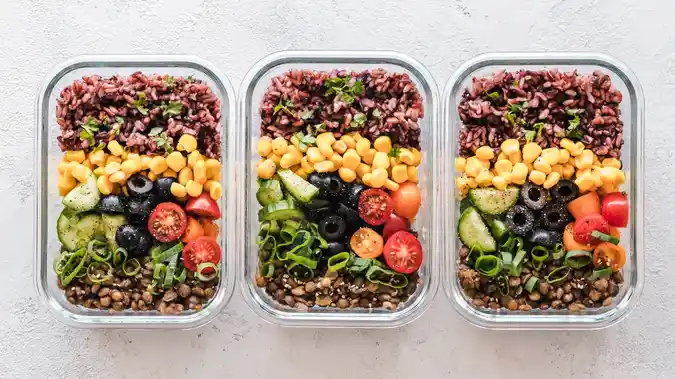
Portion the protein into meal-size containers right away.
A single large container invites overeating or forgotten leftovers. -
Store sauces separately when possible.
Wet and dry food do not age the same way. -
Reheat gently, especially for chicken, fish, and eggs.
A low oven or brief microwave bursts usually beat a hard blast, according to food-safety guidance from the USDA.
If you are using salmon, plan a shorter run and eat it earlier in the week. If you are using beans or tofu, they often hold up better for later meals. Eggs are best in smaller batches because their texture changes faster than meat or beans.
Batch cooking does not have to mean bland. It means the base is ready, so the flavor can change later.
How do you build sides that protect heart health and still taste good?
You build sides by making vegetables the volume, grains the support, and sauces the flavor.
That keeps the plate balanced without leaning on heavy cheese, salty packaged sides, or fried add-ons.
Once the protein is set, the rest of the meal has to carry weight. The smartest move is to make the vegetable dish big enough to matter, not a tiny scoop beside the main item.
A good heart-healthy plate usually starts with:
- Half the plate: non-starchy vegetables like broccoli, greens, peppers, tomatoes, cabbage, zucchini, or green beans.
- One quarter: your protein anchor.
- One quarter: whole grains or starchy vegetables like brown rice, oats, sweet potato, quinoa, barley, or corn tortillas.
Then add flavor in ways that do not rely on excess salt:
- lemon or lime juice
- vinegar
- garlic
- onion
- parsley, dill, basil, cilantro, or thyme
- yogurt-based sauces
- tomato salsa
- mustard
- roasted spices
A lot of people think the protein is the heart-healthy part and everything else is an afterthought. That is backward. A plate can be ruined by what surrounds the protein. Creamy sauces, salty sides, and huge portions of refined starch can bury an otherwise solid plan.
For a broader routine, the hub page on Heart-Healthy Meal Planning for Daily Routines — The Complete Guide can serve as the bigger map, and this article can handle the weekly protein setup. For general plate-building advice, the USDA MyPlate guide is also useful.
What mistakes waste the whole week?
The biggest mistakes are cooking too much of the same texture, skipping backup meals, and choosing sides that all taste alike.
Those errors waste food and make the plan feel harder than it should.
If the week starts strong but fades by day three, the problem is usually one of four avoidable missteps.
-
Overcooking the protein: This costs you moisture and makes leftovers less appealing.
Do instead: pull it early, slice it thin, and reheat gently with sauce. -
Using only one meal format: This costs you interest.
Do instead: turn the same protein into at least 2 different formats. -
Ignoring sauces: This costs you flavor and variety.
Do instead: keep 2 small sauces on hand, one bright and one creamy. -
Planning too many days from one batch: This costs you freshness.
Do instead: build around 3 to 4 days and freeze extra portions only if the protein freezes well.
There is one more trap: trying to make one protein fit every person in the house exactly the same way. That rarely works. A teenager may want a wrap, while another person wants a bowl. Keep the protein the same and let the format change.
On the flip side, you do not need to chase perfection. A solid one-protein plan is not fancy. It is repeatable.
When should you switch proteins midweek?
You should switch proteins midweek when the first one won’t stay fresh, the meals start to repeat too much, or your schedule changes.
That is not failure; it is smart planning.
When the first batch starts to feel too familiar, a midweek change can keep the plan alive. Monday and Tuesday may be chicken, but by Wednesday you may need a reset. This is the moment to bring in beans, eggs, or tofu for the back half of the week.
A midweek switch makes sense when:
- the first protein has a short safe-storage window for your routine
- the flavor gets tired after 2 meals
- you need a faster breakfast or lunch option
- one family member wants a different texture
- your shopping already includes another protein that fits the same sides
A common pattern is chicken early, beans later. Another is salmon for one or two meals, then eggs or yogurt-based breakfasts. If you want plant-based variety, tofu and beans make an easy pair because they do different jobs without forcing a new shopping list every time.
The point is not to prove loyalty to one protein. The point is to make the week workable. If changing proteins on Thursday keeps the plan alive, that is the better plan.
How do you make one protein last all week?
You make one protein last all week by cooking it plain, portioning it fast, and using it in different meal formats.
A batch that becomes a bowl one night, a wrap the next, and a soup later in the week feels longer than a batch that stays on one plate. Keep portions small, store sauces separately, and stop at 3 to 4 days if freshness starts to slip.
What protein is easiest to prep in batches?
Chicken, beans, and tofu are usually the easiest batch proteins because they hold up in multiple meals.
Chicken is flexible, beans need little extra work, and tofu takes on flavor well after a simple press and cook. Salmon and eggs can work too, but they usually need a shorter window and a little more attention.
Drafted with AI; not yet reviewed by a person.