Last updated: November 19, 2026
Quick answer: begin with one ingredient swap, not three. In muffins or quick breads, 25% to 50% is usually enough; cakes need a lighter touch. Heart-healthy baking ingredient swaps can cut saturated fat and added sugar without turning muffins, cakes, or quick breads into dry, gummy disappointments. The trick is to swap by function, not by guesswork, because fat, sugar, eggs, and flour each do a different job in baked goods in this guide to Heart-Healthy Baking Ingredient Swaps for Muffins, Cakes, and Quick Breads.
Key Takeaways
- Many swaps can help moisture, structure, and browning, but results depend on the recipe.
- Whole wheat flour adds fiber and a nuttier flavor, while oat flour softens the crumb and can weaken structure.
- Canola oil, unsweetened applesauce, and Greek yogurt can replace butter, but each changes flavor and texture differently.
- Reduce sugar gradually and keep some in the recipe, because sugar does more than sweeten.
Which heart-healthy baking ingredient swaps actually keep muffins, cakes, and quick breads tender?
Heart-healthy baking ingredient swaps often work best when moisture, structure, and browning stay in balance. Usually, that means replacing only part of the original ingredient first, then testing a 1-cup batch or a single loaf before you scale up.
A good place to start is one swap from each category: flour, fat, sugar, and dairy. For example, whole wheat flour can stand in for some all-purpose flour, canola oil can replace butter in many quick breads, unsweetened applesauce can replace part of the oil, and Greek yogurt can replace part of the sour cream or butter-based richness in cake-style batters. For a related overview, see the ingredients hub, the baking basics guide, and the muffin recipe collection.
Most baking mishaps come from changing everything at once. Then the crumb turns dense, the rise falls flat, or the batter looks fine in the bowl and bakes up heavy anyway. One controlled swap per category gives you a clearer read.
What do whole wheat flour and oat flour change in the crumb?
Whole wheat flour adds fiber and a nuttier flavor. Oat flour softens the crumb, but it can also make the structure more delicate. Both belong in heart-healthy baking; neither acts exactly like all-purpose flour.
For muffins and quick breads, start with a 25% to 50% swap: replace 1 cup of all-purpose flour with 1/2 cup all-purpose flour plus 1/2 cup whole wheat flour, or with oat flour if you want a milder flavor. In cakes, keep the swap smaller, closer to 25%, because cake batter depends on a finer, lighter crumb. A full 1:1 swap with whole wheat flour usually makes cake feel heavier and drier.
Oat flour absorbs liquid differently from wheat flour. After 5 minutes, a thicker batter is normal; oats need time to hydrate. Add 1 to 2 tablespoons of milk, yogurt, or another liquid only if the batter becomes paste-like. Too much extra liquid can turn a loaf dense in the middle.
Whole wheat pastry flour is a useful middle ground if you can find it. It has less of the coarse, bran-heavy texture that makes standard whole wheat flour feel rugged in delicate cakes. If the recipe already includes fruit, spices, or cocoa, whole wheat flour usually blends in better than it does in a plain vanilla batter.
Angel food-style cakes, chiffon cakes, and anything built around a very fine, airy crumb are a different story. Those formulas depend on precision and do not forgive heavier flour.
Canola oil, applesauce, and Greek yogurt: how do they replace butter?
Canola oil, unsweetened applesauce, and Greek yogurt can replace butter, but each one changes flavor and texture in a different way. Butter brings flavor, fat, water, and air; no single substitute copies all four jobs.
Here is a practical way to think about the swap:
- Canola oil gives the most reliable moisture in muffins and quick breads.
- Unsweetened applesauce cuts fat and adds softness, but too much can make a batter sticky or cakey.
- Greek yogurt adds tang and body, and it works especially well where some acidity helps lift the batter.
For many quick breads, oil can replace butter in a 1:1 volume swap. That often gives a softer, moister loaf because oil stays liquid at room temperature. Canola oil is a common choice because its neutral flavor does not fight with cinnamon, banana, pumpkin, or lemon.
Applesauce works better as a partial replacement. A common pattern is to swap out half the butter or oil for applesauce, not all of it. If a recipe calls for 1/2 cup butter, use 1/4 cup butter and 1/4 cup applesauce. Go all the way to 1/2 cup applesauce, and you should expect a softer, more compact crumb with less browning.
Greek yogurt fits nicely in place of some butter, sour cream, or buttermilk-style richness. In cakes and quick breads, 1/4 to 1/2 cup Greek yogurt can add moisture without the greasy feel that sometimes comes from extra oil. Use plain, unsweetened yogurt so you control the sugar level.
Flavor is the trade-off. Butter brings a round, rich taste that these substitutes do not fully match. If the recipe is butter-forward, such as a simple pound cake, a full swap may leave the result flat. That is not a flaw in the ingredient; it is the formula showing you what it needs.
How do you reduce sugar without ruining texture?
Reduce sugar gradually, and keep some of it in the recipe. Sugar does more than sweeten; it helps tenderness, browning, and moisture retention, especially in muffins and cakes.
A cautious first step is to cut granulated sugar by about 10% to 25%. In a recipe with 1 cup sugar, start by removing 2 to 4 tablespoons rather than half the amount. That small cut often goes unnoticed in spice breads, banana bread, zucchini bread, and citrus muffins. A larger cut can make the crumb bland, pale, and dry.
Want to go lower? Use flavor to carry the loss. Cinnamon, nutmeg, vanilla, citrus zest, and ripe banana all make a lower-sugar batter taste fuller without adding much sweetness. That matters in a loaf that may already contain fruit.
Another useful tactic is to choose a naturally sweeter ingredient, not a sweetener bomb. Mashed banana can soften the need for extra sugar in banana muffins or breakfast bread. Unsweetened applesauce can also add mild sweetness, though it is more useful for moisture than for replacing sugar fully.
Do not swap sugar one-for-one with a liquid sweetener unless you also adjust the wet ingredients. Liquid sweeteners can make the batter too loose and can change how quickly the top browns. That is especially risky in cake layers, where the edge may overbrown before the center sets.
When a recipe depends on creaming butter and sugar together for air, a deep sugar cut changes the rise. In that case, lower the sugar a little, not a lot, and rely on leavening for lift rather than expecting the batter to behave the same way.
What is an egg substitute when the recipe needs structure?
An egg substitute depends on whether the recipe needs binding, lift, or moisture, because eggs do all three jobs at once. In muffins and quick breads, a flax “egg,” yogurt, or applesauce may work; in cakes, the formula is less forgiving.
For 1 egg, a practical binder is 1 tablespoon ground flaxseed mixed with 3 tablespoons water, rested for about 5 minutes until thick. This helps hold together oatmeal muffins, banana bread, and other dense batters. It does not mimic the rise or lightness of whipped eggs in a sponge cake.
Greek yogurt can also stand in for part of the moisture from eggs, especially in rich quick breads. Use it when the batter already contains baking powder or baking soda and does not depend on eggs for volume. Applesauce is similar: it helps with moisture and binding, but it can make the crumb tighter if overused.
When a recipe calls for 2 or 3 eggs, do not assume a straight swap with applesauce or banana will work cleanly. That much egg contributes real structure. At that point, the recipe may need a different formula, not just a replacement ingredient.
Commercial egg replacers exist, and some are designed for baking rather than scrambling. Read the package for the exact use case, because some are better for binding while others are built for aeration. In a standard muffin or loaf, the package directions matter more than the label claim.
This is one area where heart-healthy and allergy-friendly goals can overlap, but they are not identical. A recipe that works without eggs may still be high in added sugar or saturated fat, so check the whole formula, not only the egg line.
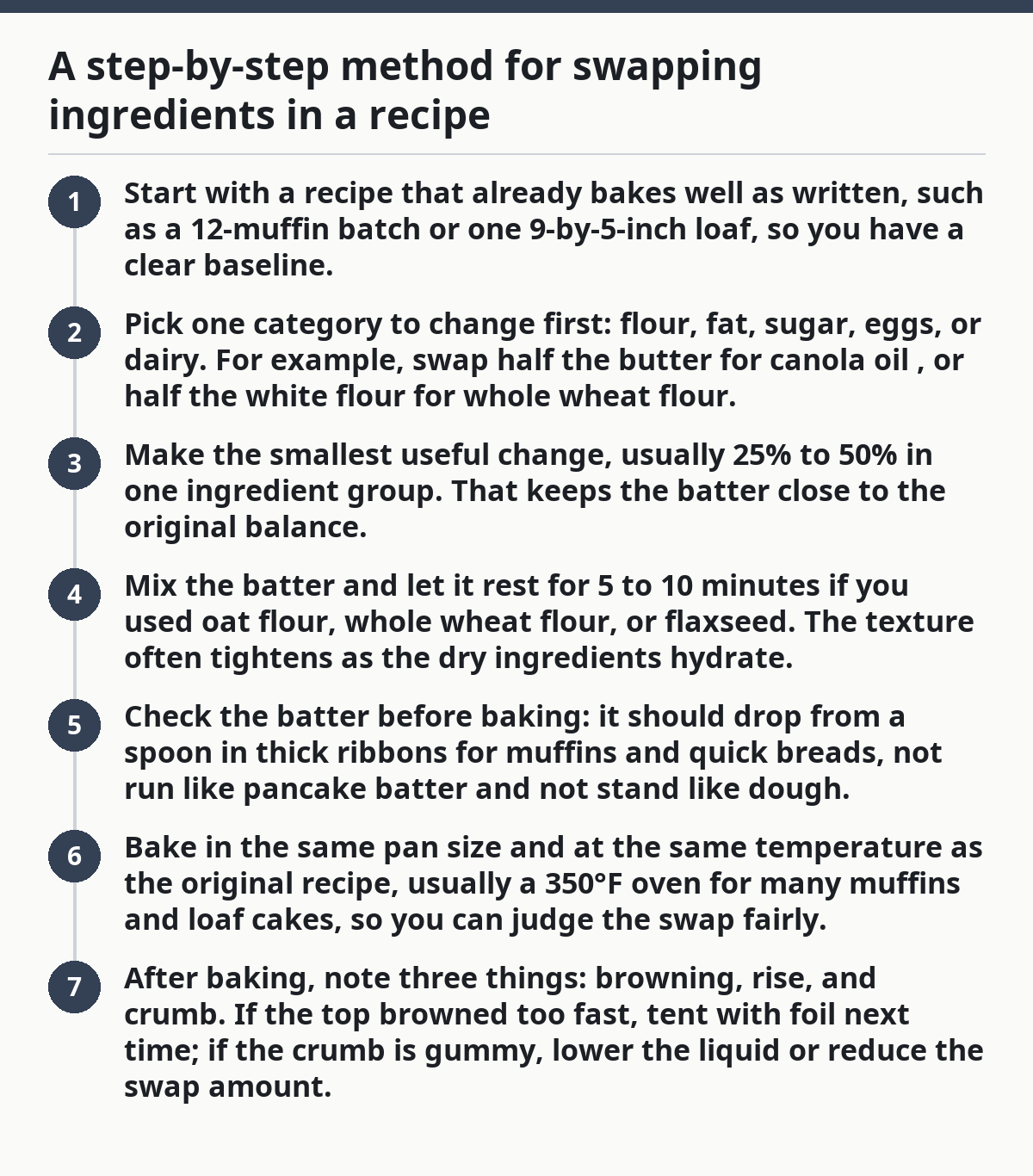
A step-by-step method for swapping ingredients in a recipe
A measured, one-change-at-a-time method gives the most reliable result. Use it when you want to adapt a familiar muffin, cake, or quick bread recipe without guessing.
- Start with a recipe that already bakes well as written, such as a 12-muffin batch or one 9-by-5-inch loaf, so you have a clear baseline.
- Pick one category to change first: flour, fat, sugar, eggs, or dairy. For example, swap half the butter for canola oil, or half the white flour for whole wheat flour.
- Make the smallest useful change, usually 25% to 50% in one ingredient group. That keeps the batter close to the original balance.
- Mix the batter and let it rest for 5 to 10 minutes if you used oat flour, whole wheat flour, or flaxseed. The texture often tightens as the dry ingredients hydrate.
- Check the batter before baking: it should drop from a spoon in thick ribbons for muffins and quick breads, not run like pancake batter and not stand like dough.
- Bake in the same pan size and at the same temperature as the original recipe, usually a 350°F oven for many muffins and loaf cakes, so you can judge the swap fairly.
- After baking, note three things: browning, rise, and crumb. If the top browned too fast, tent with foil next time; if the crumb is gummy, lower the liquid or reduce the swap amount.
This method works because it isolates the problem. Change flour, fat, and sugar all at once, and you cannot tell which swap caused the issue. A notebook entry with the ingredient amount and the bake time, even just 45 minutes for a loaf, is more useful than a vague memory.
For most bakers, the sweet spot is a controlled change, not a total makeover. The goal is a bake that still tastes like dessert or breakfast bread, but leans less on butter and sugar than the original.
Which swaps make muffins better, and which ones are wrong for cakes?
Muffins tolerate the most substitution, quick breads come next, and cakes are the least forgiving. That order matters because muffins and loaves can handle a little extra heft, while cakes depend on a fine, even crumb.
Best bets for muffins:
- Replace up to half the butter with canola oil for moisture.
- Swap up to half the flour with whole wheat flour for a nuttier, sturdier muffin.
- Use mashed banana or unsweetened applesauce to replace part of the sugar and fat in banana or spice muffins.
- Add Greek yogurt for tenderness and a slight tang.
Good bets for quick breads:
- Use a 1:1 oil swap for butter if the loaf is fruit- or spice-based.
- Use partial sugar reduction, not a drastic cut.
- Use oat flour in a portion of the flour mix for a softer, wholesome crumb.
Risky bets for cakes:
- Full butter-to-applesauce swaps usually make cake gummy.
- Large flour changes can flatten the rise.
- Heavy egg replacement can leave the cake weak and dense.
That does not mean cakes are off-limits. It means the changes should be smaller and more selective. A loaf that can survive 50% whole wheat flour may make a birthday cake taste like breakfast. If the cake is the main event, keep the swap modest and preserve texture first.
A useful rule: the more delicate the crumb needs to be, the more carefully you should swap. A blueberry muffin can forgive more than a vanilla layer cake.
Heart-Healthy Baking Ingredient Swaps: the short list that pays off
The most useful heart-healthy baking ingredient swaps are the ones that lower saturated fat and added sugar while keeping the batter balanced. Whole wheat flour, oat flour, unsweetened applesauce, Greek yogurt, canola oil, and mashed banana cover most muffin and quick-bread needs without forcing a full recipe rewrite.
The order that usually works best is simple:
- Swap part of the butter or oil.
- Reduce sugar a little.
- Replace only part of the flour.
- Adjust the wet ingredients after the batter rests.
- Stop before the texture turns heavy.
If a recipe is already rich, dense, or strongly flavored, the swaps are easier to hide. If it is a plain cake with a fine crumb, use fewer substitutions and accept a smaller health shift. That honesty matters more than chasing a perfect label claim.
For readers building a bigger pantry strategy, the ingredients hub can sit beside this guide and help you choose ingredients before you start baking. That is the right place for broad ingredient selection; this page is for the bake itself. For more practical help, see the baking basics guide, the muffin recipe collection, and the quick breads page.
What can I use instead of butter in heart-healthy baking?
Canola oil is the most straightforward substitute in many muffins and quick breads. Unsweetened applesauce can replace part of the butter for moisture, and Greek yogurt can replace some of the richness in tender cakes or loaf batters. The trade-off is flavor: butter tastes fuller, so partial swaps usually work better than total replacement.
How do I reduce sugar without ruining texture?
Cut sugar in small steps, usually 10% to 25% at a time. Sugar helps with browning and tenderness, so a big reduction can make the crumb dry or pale. Use ripe banana, cinnamon, vanilla, or citrus zest to make the lower-sugar batter taste more complete without changing the structure as much.
Which flour works best for heart-healthy muffins?
Whole wheat flour works best when you want more fiber and a sturdier muffin, while oat flour gives a softer, milder result. A 50/50 mix of all-purpose and whole wheat flour is a reliable starting point for most muffin recipes. For delicate cakes, use less whole wheat and expect a lighter hand with the swap.
Drafted with AI; not yet reviewed by a person.