
Last updated: November 19, 2026
Olive oil usually takes the crown for everyday heart-friendly cooking; canola oil is the steady backup, and avocado oil steps in when the heat climbs. Coconut oil and butter are the fats to keep on a short leash. And in practice, the best oil is the one that actually suits the pan, not the one that merely looks virtuous on a label.
Healthy cooking oils matter most when they fit the food on the stove, not just a nutrition label. So the real question for Best Oils for Heart-Friendly Recipes and Which Ones to Limit is not “Which oil is healthiest in theory?” It is “Which one actually works for sautéing, roasting, and dressings without pushing saturated fat too high?”
Key takeaways
- Olive oil is the best all-around choice for heart-friendly everyday cooking.
- Canola oil is a useful neutral option when you want little flavor and steady performance.
- Avocado oil fits high-heat recipes, but its main drawback is cost and the fact that refined versions are harder to judge by taste alone.
- Sunflower oil can work, but only the higher-oleic versions make sense as a regular pick.
- Butter and coconut oil are the ones to limit most often because they bring more saturated fat to the plate.
- Smoke point matters, but the recipe and the overall fat profile matter too.
The real difference between olive oil and canola oil in heart-friendly cooking
For most heart-friendly cooking, olive oil comes out ahead because it gives you useful kitchen performance and a favorable fat profile at the same time — especially for dressings, vegetables, beans, and low-to-medium-heat cooking. Canola oil, meanwhile, is the quieter choice when you want almost no flavor and a dependable option for baking, pan cooking, or any dish where olive oil would taste too grassy or peppery.
The nutritional split is the part people usually miss. Olive oil is rich in monounsaturated fat, and canola oil also contains a high amount of monounsaturated fat, but it tends to have more polyunsaturated fat than olive oil. That matters because heart-friendly cooking usually means swapping out saturated fats for unsaturated ones, not hunting for a single magic bottle. That math stops working fast if the goal is just a slogan.
Smoke point gets oversold. Refined olive oil and refined canola oil are both common picks for stovetop cooking, while extra-virgin olive oil still works well in plenty of everyday dishes even if people assume it is too delicate. A higher smoke point does not automatically mean a healthier oil; it only means the oil is more forgiving when the burner is up.
Use olive oil when the fat should contribute flavor and the recipe will not bury it. Reach for canola oil when you want the oil to disappear into the dish. And if the recipe already leans on butter, cream, or cheese as its main fat source, skip both if your aim is to cut saturated fat overall.
Which oil is best for heart-friendly cooking?
Olive oil is usually the best single answer for most people because it fits many heart-friendly recipes and stays easy to use week after week. Think roasted vegetables, tomato sauces, grain bowls, sautéed greens, and simple vinaigrettes. The bottle style matters more than the branding: extra-virgin olive oil brings more flavor, while refined olive oil is milder and better suited to heat.
Its strength is consistency. One bottle can dress a salad, finish a soup, or coat a pan without forcing you to switch flavor gears. Honestly, that practicality matters; an oil that stays in the cupboard because it is awkward to use helps no one.
The downside is just as real. Olive oil is not the best neutral pick for every dish, and it can crowd out delicate flavors. Lower-quality bottles can also taste flat or stale. For a recipe built around a high-heat sear and a very clean taste, it is not always the best fit.
Think of the typical home cook — vegetables, fish, chicken, beans, pasta, sauces — and olive oil makes a lot of sense. Want an oil that vanishes completely in cakes, quick breads, or ultra-neutral frying? Then canola or avocado oil may suit you better.
For an evidence-based starting point, the American Heart Association’s guidance on dietary fats is a useful reference, and Harvard’s School of Public Health has a clear explanation of dietary fats and heart health: American Heart Association fats guidance and Harvard T.H. Chan School of Public Health: Fats and Cholesterol.
Canola oil: the quiet workhorse for everyday cooking in heart-friendly recipes
Canola oil is the practical choice when the recipe needs a neutral fat that behaves well in baking, sautéing, and pan cooking. It is the least opinionated bottle in the group. Herbs, garlic, and spices stay in charge, which is exactly why it works so well in ordinary kitchens.
For heart-friendly cooking, its appeal comes from two places: it is low in saturated fat compared with butter and coconut oil, and most of its fat is unsaturated. That makes it a sensible swap when a recipe calls for melted butter, shortening, or another more saturated source. It also handles medium heat well, which is why it shows up so often in muffins, stir-fries, and quick skillet dishes.
Flavor is where opinions split. Some people find canola oil too plain, while others steer clear because they distrust highly processed oils. The real issue is simpler than that: refined canola oil is not a bold finishing oil. If you want something with character, it will disappoint; if you want a last-minute drizzle over tomatoes or toasted bread, it can feel limp.
Bakers, budget-conscious cooks who still want an unsaturated-fat option, and anyone who dislikes the taste of olive oil in sweet or delicate recipes will usually be happy with canola oil. It is not the top pick for finishing dishes where flavor is the point, and it is not the best pantry anchor if you want a few distinctive oils with strong culinary personalities.
Avocado oil and sunflower oil: where they fit in heart-friendly cooking, and where they do not
Avocado oil works well for high-heat cooking when you want a mild flavor and a more heat-tolerant refined oil. Sunflower oil only makes sense if it is the high-oleic type, not the ordinary version found in many generic bottles.
Avocado oil’s biggest strength is flexibility. It fits roasting pans, cast-iron skillets, and recipes where you want more heat tolerance than extra-virgin olive oil usually provides on paper. Its taste is mild enough to stay out of the way in vegetable sautés, sheet-pan dinners, and simple marinades. The trade-off is price and inconsistency. Some bottles are refined enough to earn their keep at high heat, while others seem chosen more for marketing than for day-to-day kitchen use. And yes, it is easy to overspend on avocado oil for jobs where olive oil or canola oil would do the same work.
Sunflower oil is trickier. Standard sunflower oil is often high in polyunsaturated fat, but that does not automatically make it the best everyday choice, especially if you use it heavily or at high heat. High-oleic sunflower oil is the better cooking version because it is more stable and better suited to repeated use in a home kitchen. The catch? Many bottles do not make the type obvious enough, and the ordinary version is easy to confuse with the better one.
Choose avocado oil if you cook a lot at higher heat and want a bland oil that will not interfere with the recipe. Choose high-oleic sunflower oil if the label clearly says so and you need a neutral, stable oil. Skip both if your priorities are value, low waste, and an oil you can use across salads and stovetop cooking without paying for a specialty bottle.
The honest side-by-side
Olive oil is the best overall choice, but the winner changes with the job. Below is the practical version, not the label version.
| Criteria | Olive oil | Canola oil | Winner for condition |
|---|---|---|---|
| Flavor in simple dishes | Distinct, fruity, sometimes peppery | Very neutral | Canola oil for baking and delicate batters |
| Everyday heart-friendly use | Excellent for vegetables, beans, fish, salads | Excellent for neutral stovetop cooking | Olive oil for daily cooking |
| Fat profile emphasis | High in monounsaturated fat | High in monounsaturated fat, with more polyunsaturated fat | Olive oil for flavor plus fat quality |
| Smoke point concern | Good for many real-world uses, especially refined forms | Generally forgiving in the pan | Canola oil for higher-heat neutrality |
| Best for dressings | Strong winner | Works, but bland | Olive oil for vinaigrettes |
| Best for sweet baking | Can be distracting | Usually better | Canola oil for cakes and muffins |
| Best for roasted vegetables | Strong flavor and good browning | Works well but adds no character | Olive oil for most roasts |
| Main drawback | Can overpower subtle foods | Can feel bland or overly refined | Depends on recipe |
| Who should skip | People who want total neutrality | People who want flavor and finishing power | Choose by dish, not habit |
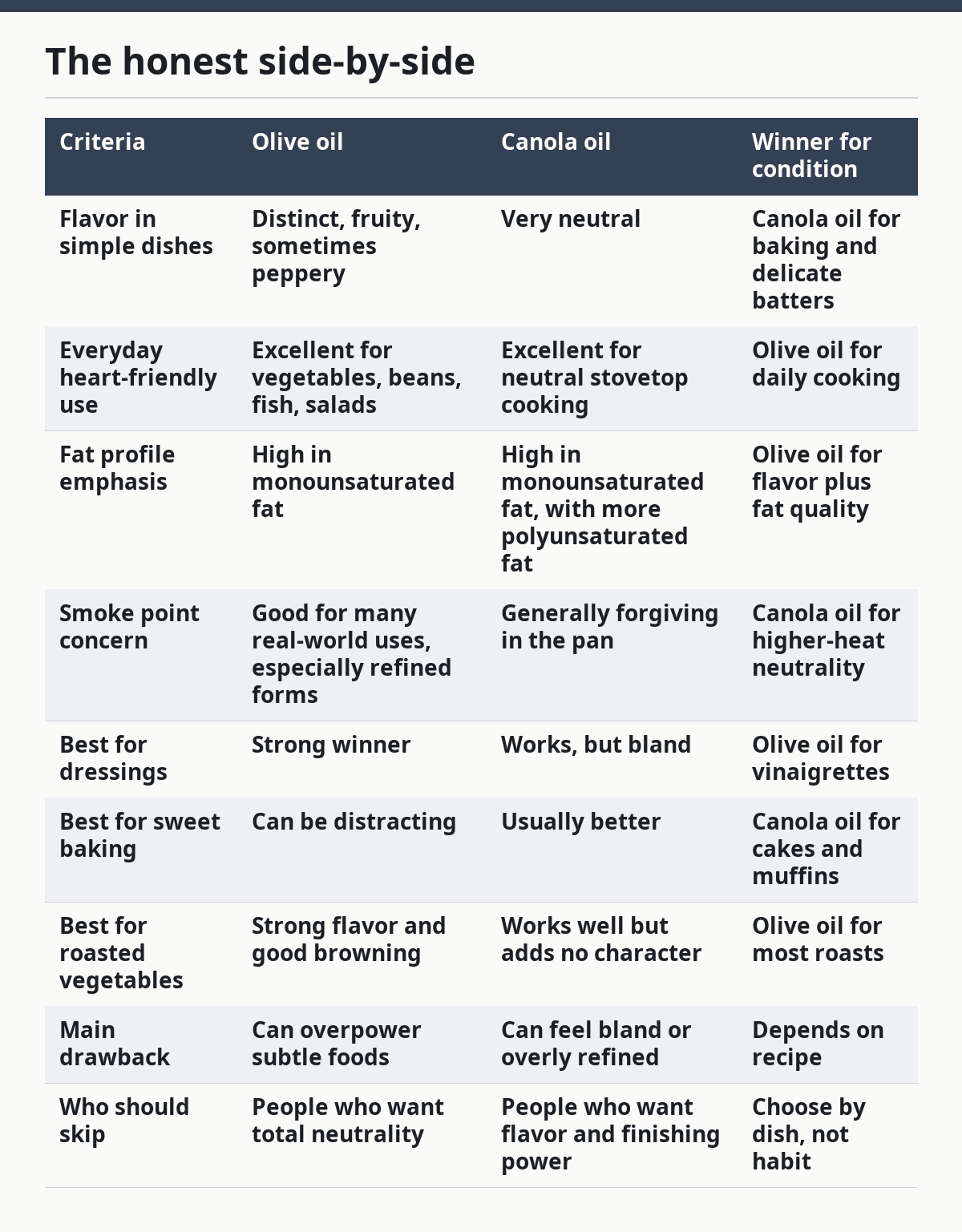
The table makes the trade-off plain: olive oil is the better default, but canola oil is the better utility player. A generic article would stop there. The more useful answer is that neither oil is wrong; the wrong move is using butter or coconut oil as your routine fat source when the goal is heart-friendly cooking.
Butter and coconut oil: the oils to limit
Butter and coconut oil should be limited because they are the easiest way to push saturated fat back up in recipes that otherwise look healthy. That does not mean they are forbidden. It means they belong in supporting roles, not at the center of your cooking.
Butter brings flavor, browning, and a familiar richness. That is exactly why people like it, and exactly why it is so easy to overuse. A teaspoon here and a tablespoon there adds up quickly across toast, eggs, vegetables, and pan sauces. If the goal is a more heart-friendly pattern, butter is the first fat I would cut back before worrying about every last drop of olive oil.
Coconut oil has a different problem. It is fashionable, but it is still high in saturated fat compared with unsaturated oils. It also does not solve a cooking problem that olive oil, canola oil, or avocado oil cannot already handle. If a recipe uses coconut oil for its flavor, that is a separate culinary call. If it is being used as a “healthy” default oil, that is the part to question.
Butter may still make sense in a pastry crust, a small finishing amount, or a dish where its flavor is the point. Coconut oil may still make sense in certain baked goods or recipes built around its taste. Neither is the best everyday choice for someone trying to cook in a more heart-friendly way. Use them as accents, and be deliberate about the rest of the meal.
For a broader framework on replacing saturated fat with unsaturated fat, the American Heart Association’s guidance is worth keeping nearby, and the USDA’s FoodData Central can help you check ingredient fat profiles when you are comparing products by label.
When to reconsider this choice entirely
The ranking changes in a few clear situations, and ignoring them leads to bad kitchen habits. High-heat searing, baking, specialty flavor, and ingredient sensitivity can all flip the choice.
Need a dessert or baked good that depends on a neutral fat? Then canola oil often beats olive oil. A vanilla cake or tender muffin usually does not benefit from olive oil’s flavor, even when the bottle is mild.
On the other hand, if the dish is finishing food where oil is part of the taste — a tomato salad, hummus, grilled vegetables, crusty bread — olive oil becomes the obvious winner.
When the pan is very hot and the oil is mostly there to stay out of the way, refined avocado oil or canola oil may be smarter than extra-virgin olive oil. That small shift can matter.
And if a recipe uses butter or coconut oil only because that is what the cook has always used, that is the moment to reconsider the recipe, not just the oil. Many dishes improve — nutritionally and practically — when the fat source shifts to an unsaturated oil with a milder profile.
The point is not to crown one oil forever. The point is to keep the right bottle next to the stove for the job in front of you. That is how healthy cooking oils earn their place in a heart-friendly kitchen.
Drafted with AI; not yet reviewed by a person.