Last updated: November 20, 2026
Quick answer: pack 3 snacks for a long meeting day—one shelf-stable, one cold if you have an ice pack, and one backup item—so you can eat in 5 minutes between meetings. In this guide to How to Pack Heart-Healthy Snacks for a Long Meeting Day, the goal is simple: choose a few nonperishable items, add one cold item if you have an ice pack, and portion everything into spill-proof containers you can carry in a work bag. For more on the overall pattern, see heart-healthy eating and the DASH Eating Plan.
Key takeaways
- Build each snack around one protein and one fiber source, not just one bag of crackers.
- Use containers that seal tightly, because a crushed bag or leaky cup can ruin the rest of your day.
- Keep at least one snack shelf-stable so you still have food when meetings run long.
- Pick foods that are easy to eat in a conference room without a knife, fork, or a big mess.
- If lunch may disappear, pack enough for 2 snack breaks and 1 more filling backup item.
What should go in the bag?
Pack snacks that are easy to open, hard to spill, and balanced enough to keep you full. For a long meeting day, that usually means nuts, fruit cups, seed crackers, cheese sticks, and trail mix, plus one or two extra items if lunch is uncertain.
A smart snack does three jobs at once. It gives protein, it gives fiber or another slow-digesting carb, and it survives 4 to 8 hours in a work bag without turning into crumbs or a mess. That is why plain crackers alone do not hold up well, while nuts plus fruit or a cheese stick plus seed crackers usually do. For more examples, see easy workday snacks and healthy snacks.
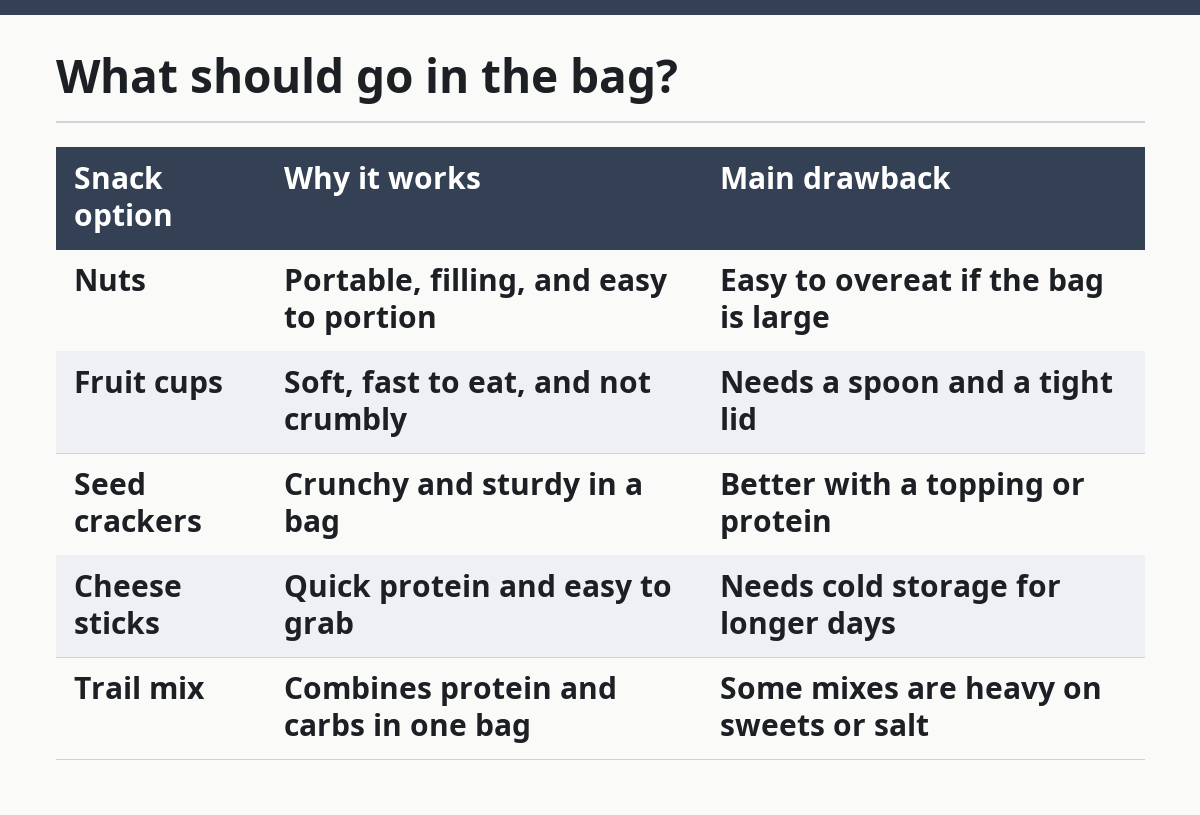
Here is a simple way to think about it:
| Snack option | Why it works | Main drawback |
|---|---|---|
| Nuts | Portable, filling, and easy to portion | Easy to overeat if the bag is large |
| Fruit cups | Soft, fast to eat, and not crumbly | Needs a spoon and a tight lid |
| Seed crackers | Crunchy and sturdy in a bag | Better with a topping or protein |
| Cheese sticks | Quick protein and easy to grab | Needs cold storage for longer days |
| Trail mix | Combines protein and carbs in one bag | Some mixes are heavy on sweets or salt |
The best bag is not the one with the most items. It is the one that gives you 2 or 3 real eating options without forcing you to hunt for a microwave or a cafeteria. For a meeting-heavy day, that matters more than any perfect menu.
How do you pack snacks so they do not leak or crush?
Pack them in rigid, spill-proof containers, then place the heaviest item at the bottom of the bag. That keeps fruit cups upright, stops trail mix from leaking into your laptop sleeve, and protects cheese sticks from getting flattened.
Use containers with tight lids for anything wet or sticky. A fruit cup belongs in its own sealed container or sleeve, not loose beside papers. Trail mix and nuts do fine in small reusable containers or zip-top bags, but a hard-sided box keeps them from turning into dust if the bag gets packed tight.
A simple packing order helps:
- Put the heaviest container on the bottom, such as a small box of trail mix.
- Set the most fragile item, like a fruit cup, along a side wall.
- Slide in cheese sticks or seed crackers in a flat layer.
- Leave one easy-open snack on top for the first break.
If you carry a laptop or notebook, keep food in a separate pouch. That sounds obvious, but it saves you from the one thing that ruins a meeting day faster than hunger: a sticky spill in the same bag as your charger.
For heart-healthy eating, the American Heart Association and the NHLBI’s DASH Eating Plan both point toward foods that fit this pattern: nuts, fruit, and other simple, less-processed choices. Their guidance is a useful frame when you are choosing what earns bag space and what does not.
- American Heart Association: https://www.heart.org/en/healthy-living/healthy-eating
- NHLBI DASH Eating Plan: https://www.nhlbi.nih.gov/health/dash-eating-plan
How do you choose snacks that keep you full?
Choose snacks that pair protein with fiber so you stay steady through a 60-minute meeting, not hungry again 20 minutes later. That means nuts with fruit, cheese sticks with seed crackers, or trail mix with mostly nuts and seeds rather than candy pieces.
Protein helps a snack feel like food. Fiber slows the pace of eating and makes a small portion last longer. A fruit cup by itself can be fine when you just want something light, but it may not carry you through a long afternoon. Add nuts or a cheese stick, and the snack does more work. For a broader guide, see protein-rich snacks and fiber-rich snacks.
A useful rule is to avoid snacks that are all crunch and no substance. Pretzels, chips, and sweet granola bars can be easy to pack, but they often leave you wanting another snack 30 minutes later. That is not a moral failure; it is a design problem.
If you want a quick formula, use this:
- 1 protein item, such as a cheese stick or a small handful of nuts
- 1 fiber item, such as fruit or seed crackers
- 1 backup item, such as trail mix, in case lunch gets pushed back
That mix matters even more on a day with back-to-back calls, because you may only get 2 short breaks. A snack that does not satisfy wastes the break and forces you to think about food again the rest of the afternoon.
Which snacks work best without a fridge?
The best nonperishable snacks are often nuts, seed crackers, and trail mix, because they handle a long day in a bag better than fresh produce or dairy. Fruit cups can also work if they are shelf-stable and sealed, but they still need careful packing so they do not open in transit.
Nonperishable food gives you insurance. If a meeting runs long, the train is delayed, or you never find the break you expected, you still have something to eat. That is the real reason these snacks matter: they lower the chance of arriving at dinner starving and making a fast, poor choice.
Here is the trade-off:
- Nuts: sturdy and filling, but easy to overpack because they are small.
- Seed crackers: crisp and tidy, but they are better with another item.
- Trail mix: useful because it combines textures, but some bags are packed with candy or salty extras.
- Fruit cups: convenient and soft, but not as satisfying on their own.
- Cheese sticks: helpful protein, but they need cold storage for a long stretch.
This is also where the wrong kind of “healthy” snack can backfire. A box of sweet snack bars may look convenient, but if it has little protein or fiber, it does not solve the meeting-day problem. A simpler mix of nuts, crackers, and fruit usually does a better job. For label-reading help, see how to read food labels.
What should you pack if lunch may disappear?
Pack a snack that can become a small meal if lunch gets missed. That means you need at least one larger protein item, one fiber-rich side, and one shelf-stable backup so the day does not depend on a lunch break that may never come.
The difference between a snack and a backup meal is mostly portion size and balance. A cheese stick plus seed crackers and a fruit cup may be enough for a short gap between meetings. If lunch is in doubt, add trail mix or a second nut portion so you have something with more staying power.
A useful layout for a long meeting day looks like this:
- Morning: nuts or trail mix
- Midday: cheese stick plus seed crackers
- Late afternoon: fruit cup or another nut portion
That gives you 3 separate eating points without turning your bag into a full cooler. It also keeps you from using all your best snacks before noon, which is the easiest mistake to make when the calendar is packed.
Do not rely on one large snack to cover the whole day unless you know there will be no lunch. A single oversized bag of trail mix can be too easy to finish too fast. Three smaller portions spread across the day usually work better and keep your energy steadier.
What mistakes cost you the most?
The biggest mistakes are packing snacks that are too messy, too salty, or too one-note. Those choices cost you time, hunger control, and sometimes a ruined bag because of leaks or crumbs.
A few common problems show up again and again:
- Loose fruit cups without a tight container cost you clean-up time if they tip over.
- Giant bags of trail mix cost you control, because they are easy to eat too quickly.
- Crackers without protein cost you fullness, since they may not hold you past the next meeting.
- Dairy without cold storage costs you food safety and convenience over a long stretch.
The fix is not complicated. Use smaller portions, pair foods, and put wet items in their own container. If you know you will be in meetings from morning to late afternoon, pack for 2 snack breaks and 1 backup. That is more useful than packing one ideal snack and hoping the day cooperates.
There is one more trade-off worth saying plainly: a heart-healthy snack that is also practical for meetings may not be as polished as a food blog box. It just needs to be easy to eat, easy to carry, and steady enough to keep you from reaching for the nearest vending machine.
How do you keep snacks fresh in a bag?
Keep snacks fresh by separating dry and wet foods, using tight lids, and adding a cold pack when you pack cheese sticks or other dairy. That protects texture and keeps the food useful when the day stretches past the lunch hour.
Freshness is mostly about temperature and pressure. A fruit cup stays better when it is upright in a hard container, and crackers stay crisp when they are not packed under a heavy notebook. If you are bringing cheese sticks, a small insulated lunch bag is better than tossing them into a warm tote.
A few practical habits help:
- Chill the cold items before you leave.
- Pack the cold items together so they stay cold longer.
- Keep dry items in a separate section or pouch.
- Eat the most delicate item first if the day is running long.
This is the part many generic snack lists skip. A snack is only useful if you can still eat it at 2 p.m. in a conference room without opening a soggy container or finding crushed crackers. The container matters as much as the food.
What snacks are best for a long work meeting day?
For a long work meeting day, the most practical snacks are the ones that are neat, filling, and easy to eat in a few bites. Nuts, fruit cups, seed crackers, cheese sticks, and trail mix are strong choices because they travel well and do not need a full meal setup.
The best pairings are protein plus fiber, such as nuts with fruit or cheese sticks with seed crackers. That mix can help you stay satisfied through back-to-back meetings instead of feeling hungry again right away.
How do you keep snacks fresh in a bag?
Keep snacks fresh by using separate containers, tight lids, and a cold pack for cheese sticks or other dairy. Dry items last better in hard-sided containers than in loose zip bags that get crushed under a laptop or notebook. The USDA’s food safety guidance also recommends keeping perishable food cold, at 40°F or below, which is the safest target for dairy in a bag. See USDA food safety basics and FDA food safety for snacks.
If the day is long, pack wet foods upright and keep them away from papers. That helps prevent leaks and can keep crackers from turning soft. When in doubt, a professional food-safety resource is the safest reference for storage and transport.
What should you pack if you may miss lunch?
Pack enough food to make 2 snacks into a light meal. A good backup is nuts or trail mix plus a cheese stick and seed crackers, or a fruit cup with another protein item.
If lunch might disappear, do not rely on one small snack. A little extra food in the bag gives you a real backup instead of a sugar crash and a long wait until dinner.
For more snack-building ideas, this page fits the larger heart-healthy snack and small-meal assembly guide without repeating the full lunch plan.
Drafted with AI; not yet reviewed by a person.