Last updated: November 19, 2026
Quick answer: Build one main meal, two snacks, and one backup dinner for each travel day. In How to Build a Heart-Healthy Meal Plan for Travel Days and Late Nights, that simple setup helps you keep salt, saturated fat, and chaos lower when your schedule falls apart. Travel days and late nights make heart-healthy eating harder because you’re stuck with limited time, limited food, and tired judgment. The fix is a simple backup plan with portable snacks, refrigerated meals, and one grocery stop. The steps below show how to keep salt, saturated fat, and chaos lower when your schedule falls apart.
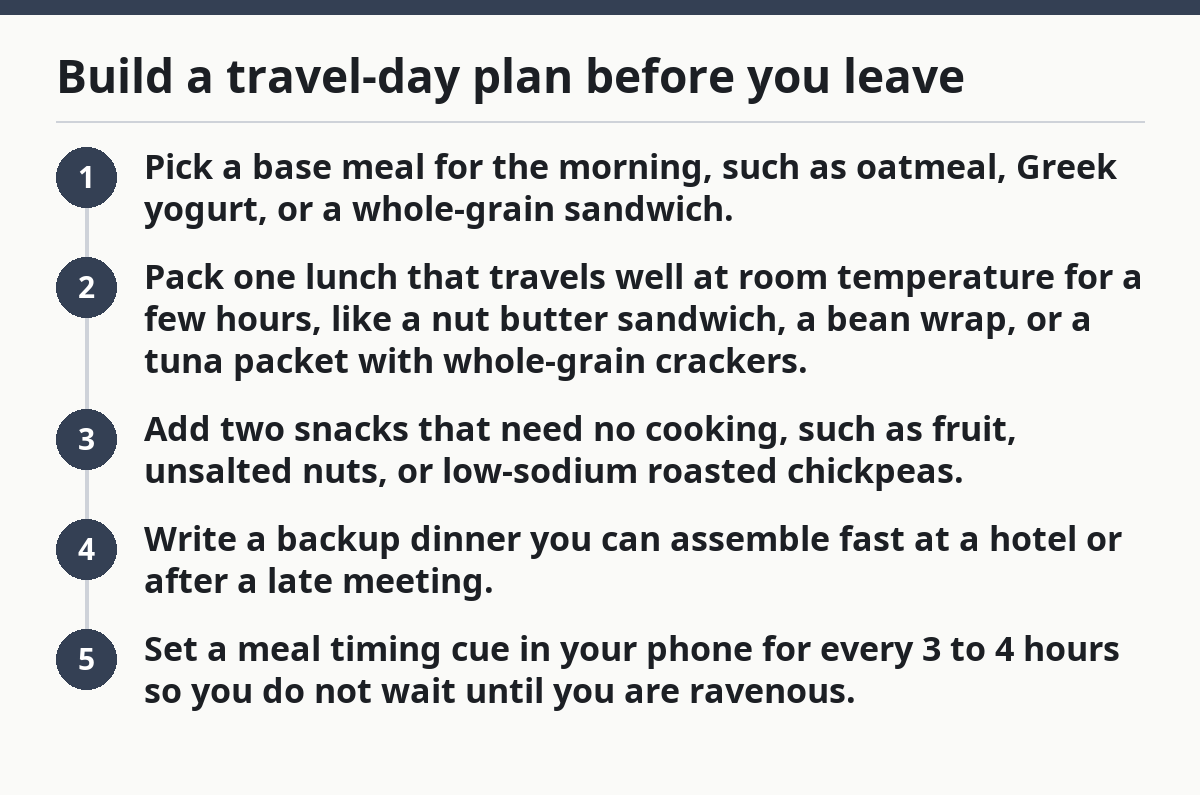
Build a travel-day plan before you leave
Start with a 24-hour food plan. If you know you’ll be on the move, map out breakfast, one portable lunch, one backup dinner, and two snacks before you pack a bag.
If your day starts before dawn and ends after dark, that plan matters even more. Picture this: you’re leaving at 5 a.m., your first meal might be in an airport, and dinner could land after 9 p.m. A plan with three named meals and two fallback foods keeps you from grabbing the first salty option in sight. That matters most on days when your usual routine is gone.
- Pick a base meal for the morning, such as oatmeal, Greek yogurt, or a whole-grain sandwich.
- Pack one lunch that travels well at room temperature for a few hours, like a nut butter sandwich, a bean wrap, or a tuna packet with whole-grain crackers.
- Add two snacks that need no cooking, such as fruit, unsalted nuts, or low-sodium roasted chickpeas.
- Write a backup dinner you can assemble fast at a hotel or after a late meeting.
- Set a meal timing cue in your phone for every 3 to 4 hours so you do not wait until you are ravenous.
A travel day is not the day to improvise every meal.
It’s the day to pre-decide.
You do not need a different menu for every trip. The simpler your plan, the easier it is to shop for and repeat.
What should I eat on travel days?
Eat meals that travel well, hold up without fuss, and do not rely on heavy sauces or fried sides. The goal is simple food with a short ingredient list and enough fiber to keep you steady between stops.
That matters because airport food, gas station food, and hotel minibar food rarely give you a heart-healthy spread by default. A better plan uses portable snacks, a cooler bag, and one or two refrigerated meals so you are not trapped by what is sold nearby.
Good travel-day choices include:
- Whole-grain wraps with hummus, turkey, or beans
- Plain oatmeal cups with nuts and fruit
- Fruit that travels well, including single-serve fruit cups packed in juice, apples, pears, or bananas
- Low-sodium soup in a thermos
- Plain yogurt with berries, if you have an ice pack
- Unsalted nuts in a small container
- Whole-grain crackers with tuna or salmon packets
A full meal does not have to be hot.
It has to be balanced.
For a heart-healthy pattern, aim for a plate that leans on vegetables or fruit, then adds a lean protein and a whole grain. That basic shape lines up with the American Heart Association’s diet guidance and sodium advice, which support this kind of planning. See the American Heart Association’s diet guidance and sodium advice for the broad rules that support this kind of planning.
Pack food that survives an airport, car ride, or hotel delay
Pack food in a cooler bag, sealed containers, and one backup meal per day of travel. The point is not to carry a full kitchen; the point is to avoid being cornered by a delayed flight or a late checkout.
If your flight is pushed back 2 hours, the conference runs long, and every nearby option is fries or pizza, a cooler bag with a small ice pack and a hotel microwave plan can save the day. It also keeps you from skipping meals and then overeating at night.
Use this packing list:
- One refrigerated meal for the first part of the day, if you have access to cold storage
- One shelf-stable lunch or dinner
- Two to three snacks
- A bottle you can refill with water
- A fork, spoon, and napkin
- A small container for leftovers
The trick is to pack by use, not by category.
Food should have a job.
A few examples work especially well:
- Oatmeal packets plus nuts and a banana
- Bean salad in a sealed container
- A turkey or hummus wrap
- Whole-grain pita, baby carrots, and hummus
- Apple slices and peanut butter
The trade-off is weight and space. A cooler bag takes up room, and refrigerated food needs a place to stay cold. If you will have no cold storage at all, lean more on shelf-stable foods and less on dairy or cooked meat.
How do I handle hotel nights and late dinners?
Handle late nights by keeping dinner small, low-salt, and easy to heat in 5 minutes or less. The goal is to stop the “I missed dinner, so I’ll eat anything” spiral.
If you get back to the hotel at 10:15 p.m., tired and hungry, with zero patience for a restaurant line, a sensible late-night meal uses a hotel microwave, a few grocery items, or a cold plate that can be eaten without cooking. That is where a simple grocery stop matters.
If you can swing a quick store run, buy:
- Prewashed salad greens
- A rotisserie chicken breast or plain cooked chicken strips
- Microwavable brown rice or quinoa cups
- Plain yogurt
- Fruit
- Low-sodium soup
- Whole-grain bread or wraps
Then build one of these in 10 minutes:
- Salad greens + chicken + beans + olive oil and vinegar
- Brown rice + soup + fruit
- Wrap with hummus, greens, and sliced chicken
- Yogurt + fruit + nuts if you truly need something light
Skip creamy dressings, giant portions, and salty deli meats when you can. They can leave you thirsty and puffy the next morning. A late meal should calm your hunger, not turn into a second problem.
A grocery stop also gives you control for the next day too.
That can save time.
For a broader food framework, the Dietary Guidelines for Americans from the U.S. Department of Agriculture and the U.S. Department of Health and Human Services are a reliable source for building meals around vegetables, fruit, grains, protein foods, and oils.
Use timing to keep hunger from turning into bad choices
Time your food every 3 to 4 hours and protect one real meal, not just snacks. Most travel trouble starts when a person goes too long without eating and then accepts whatever is nearest.
A lot of generic advice tells you to “snack smart.” That is too vague. The better move is to place food before the crash. Eat breakfast before you leave if you can. Carry one snack for the middle of the day. Keep a second snack for the stretch between dinner and bedtime.
Use this timing pattern:
- Breakfast before departure, or within the first hour of travel
- Snack around the middle of the trip
- Lunch or your main meal when you have a stop with decent options
- One late snack only if dinner will be delayed past 8 p.m. or your schedule is uncertain
If you wait too long and tell yourself you will “just eat later,” that often turns into eating too much later.
That backfires.
This is where portion size helps. A snack should take the edge off, not act like a meal. A banana plus nuts, yogurt plus fruit, or crackers plus hummus can bridge a gap without sending you straight into a heavy dinner.
Do not use travel as a reason to skip protein for the whole day.
You will feel it.
What are the biggest mistakes on travel days?
The biggest mistakes are skipping meals, relying on fast-food defaults, and forgetting cold storage. Each one pushes you toward more salt, less fiber, and a messier night.
If you leave the house with no food, tell yourself you’ll “figure it out,” and end up eating pretzels, fries, and a giant late dinner, the cost is not just one bad meal. It is a day of up-and-down hunger, more sodium, and less control over what comes next.
Common mistakes and better moves:
- Skipping breakfast: This often leads to overeating later. Eat something small before you leave, even if it is just oatmeal or yogurt.
- Packing only snacks: This can leave you hunting for a full meal when you need one. Bring at least one real meal.
- Choosing only salty convenience foods: That can leave you thirsty and bloated. Keep fruit, nuts, and whole grains in the mix.
- Ignoring storage needs: Dairy, cooked meat, and salad kits spoil without cold storage. Use a cooler bag or buy shelf-stable foods instead.
- Waiting until 11 p.m. to eat dinner: This often leads to oversized portions or heavy takeout. Plan a smaller meal earlier, or keep ingredients ready for a fast hotel meal.
If you have a heart condition, kidney disease, or another reason to limit fluids or sodium more tightly, use this framework only as a starting point and check the details with a qualified clinician or dietitian. Travel changes the rules fast.
Put your plan on one grocery stop
Put your plan into a 15-minute grocery stop by buying one meal, two snacks, and one backup breakfast. That one stop is often enough to turn a chaotic travel day into a workable one.
If you arrive at a hotel near 7 p.m., tired and short on choices, but you have a store across the street, a short list keeps you from wandering the aisles and grabbing random packaged food.
Use this shopping set:
- One ready-to-eat protein: rotisserie chicken, tuna packets, tofu, or beans
- One grain: whole-grain bread, wraps, microwave rice, or oats
- Two produce items: berries, apples, bananas, salad greens, or carrots
- Two snacks: nuts, hummus cups, yogurt, or fruit cups
- One drink: water, unsweetened tea, or low-sugar electrolyte drink if needed
If your room has a hotel microwave, add a microwavable grain cup or a bowl of low-sodium soup. If it does not, stick to food that eats cold. That is the cleanest way to avoid waste.
The simple rule is this: buy what you can assemble in 5 minutes.
Not more.
Travel-day meal planning works best when it is boring on purpose. Repeated, plain, and ready beats ambitious food that falls apart by 9 p.m. This is the kind of plan that fits into a suitcase, a lunch bag, and a late-night check-in.
Key Takeaways
- Build the day before you travel, not after hunger hits.
- Carry one real meal, two snacks, and a backup dinner.
- Use a cooler bag for cold food and shelf-stable food for long gaps.
- Match meal timing to the trip so you do not get trapped by a late-night hunger spike.
- Keep one grocery stop in your pocket for hotel nights and delays.
- Skip the all-snack plan; it leaves you short when you need a full meal.
For the broader routine that supports this plan, see the hub on Heart-Healthy Meal Planning for Daily Routines.
what should i eat on travel days?
Eat food that holds up well, sits light, and does not depend on fried sides or heavy sauces. A good travel day usually starts with oatmeal, yogurt, eggs, or a whole-grain sandwich, then moves to fruit, nuts, a wrap, or soup later on.
how do i keep healthy eating on the road?
Keep healthy eating on the road by packing food before you leave, timing meals every few hours, and making one grocery stop if the day runs long. A cooler bag, portable snacks, and a backup dinner stop most of the damage before it starts.
what are good backup meals for late nights?
Good backup meals for late nights are fast, plain, and easy to heat in a hotel microwave. Think salad greens with chicken, microwavable brown rice with soup, a hummus wrap, or yogurt with fruit if you need something light and quick.
Drafted with AI; not yet reviewed by a person.