Last updated: November 19, 2026
Quick Answer: The 8 best heart-healthy side dishes for dinner are roasted vegetables, steamed green beans, brown rice pilaf, quinoa, bean salad, lentil salad, mashed cauliflower, and baked sweet potatoes. Heart-healthy side dishes for dinner are the ones that add fiber, potassium, and flavor without piling on sodium, saturated fat, or heavy sauces. The best picks are often vegetables, beans, intact grains, and simple starches dressed with olive oil, herbs, citrus, or yogurt.
If dinner keeps ending up centered on the main dish, the side is where the heart-friendly upgrade happens. A good side can turn a plain piece of fish, chicken, tofu, or beans into a balanced plate without making the meal feel like a diet. This guide focuses on Best Heart-Healthy Side Dishes for Dinner, not full recipes, so the ideas fit into real weeknight dinners. For broader meal planning, the heart-healthy dinners hub and our healthy weeknight dinners guide can help.
The side dishes that do the most for dinner
The most useful heart-healthy side dishes are roasted vegetables, brown rice pilaf, lentil salad, steamed green beans, quinoa, mashed cauliflower, bean salad, and baked sweet potatoes. Those foods show up again and again because they give dinner bulk, texture, and nutrients without needing much added salt.
The reason they work is practical. Vegetables bring volume and color. Beans and lentils bring fiber and plant protein. Brown rice and quinoa give a sturdier base than white bread or creamy casseroles. Sweet potatoes and cauliflower do useful jobs too: one adds natural sweetness and starch, the other gives a creamy side with far less butter than mashed potatoes. The common thread is restraint. A side dish does not need a rich sauce to be satisfying.
A few shortcuts make the list easier to use:
- Choose 1 vegetable side when the main dish is rich, such as salmon with a glaze or chicken thighs.
- Choose 1 grain or starchy side when the main is lean, such as grilled fish or skinless chicken breast.
- Choose 1 bean or lentil side when dinner needs more staying power.
- Keep sodium in check by starting with unsalted broth, no-salt-added canned beans, or plain grains.
A simple rule helps: if a side dish would taste good with lemon, garlic, parsley, pepper, or cumin, it probably belongs on a heart-healthy dinner table. If it depends on cheese sauce, bacon, or a salty packet mix, it usually belongs on the occasional list, not the weeknight list.
For the larger dinner picture, this page supports the main heart-healthy dinners hub without repeating full meal plans. If you want more side-dish ideas, our healthy side dishes and vegetable side dishes pages are useful next stops.
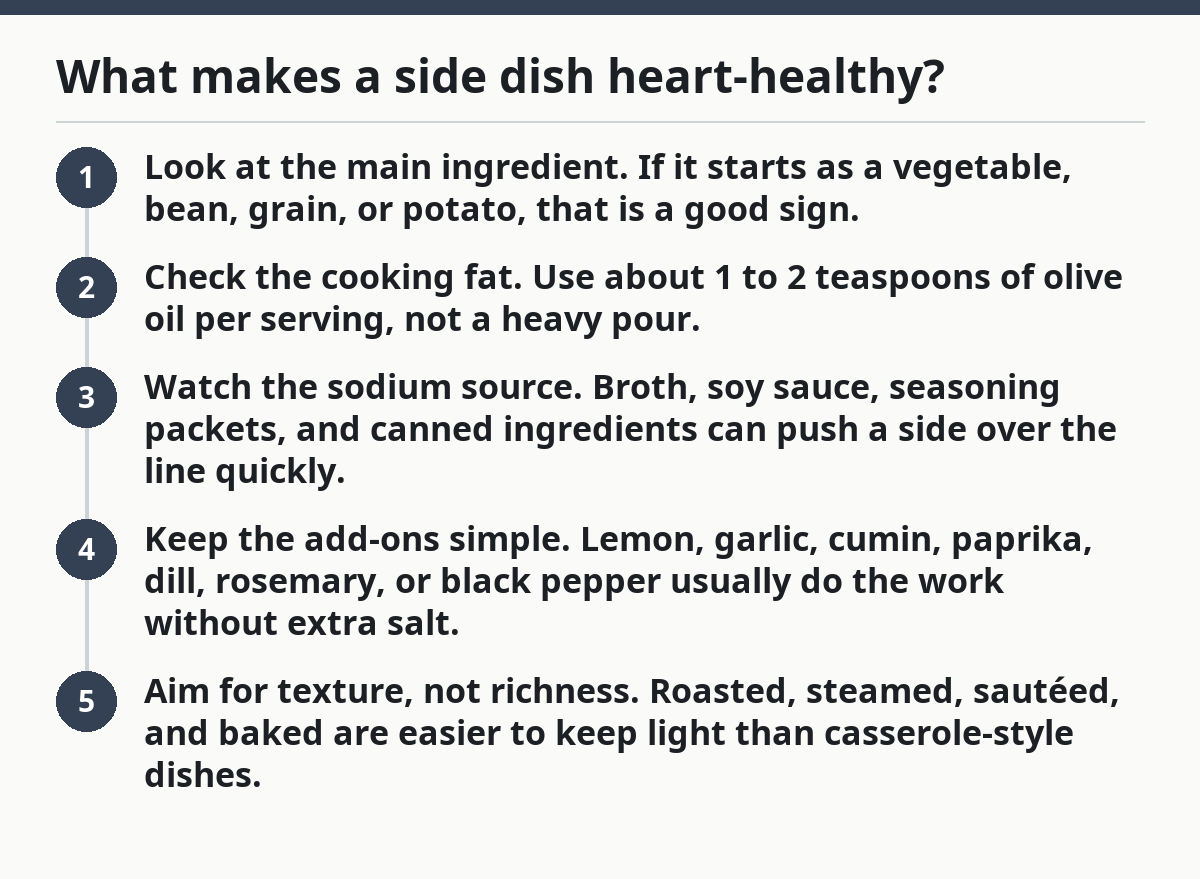
What makes a side dish heart-healthy?
A heart-healthy side dish is usually built from whole or minimally processed foods and finished with small amounts of unsaturated fat, herbs, vinegar, or citrus instead of heavy cream and excess salt. That usually means one serving has vegetables, beans, lentils, whole grains, or potatoes prepared plainly.
The American Heart Association’s general eating pattern advice points in this direction: more vegetables and whole grains, less sodium, and fewer foods high in saturated fat. The exact side dish matters less than the pattern across the plate. A pan of roasted carrots with olive oil and thyme is a better fit than canned creamed corn, even if both are technically “vegetables.” The difference is in the added ingredients. For packaged foods, the FDA’s general labeling rules are a helpful reference point, and the American Heart Association’s guidance is another good benchmark.
Here is the practical test I would use for a dinner side:
- Look at the main ingredient. If it starts as a vegetable, bean, grain, or potato, that is a good sign.
- Check the cooking fat. Use about 1 to 2 teaspoons of olive oil per serving, not a heavy pour.
- Watch the sodium source. Broth, soy sauce, seasoning packets, and canned ingredients can push a side over the line quickly.
- Keep the add-ons simple. Lemon, garlic, cumin, paprika, dill, rosemary, or black pepper usually do the work without extra salt.
- Aim for texture, not richness. Roasted, steamed, sautéed, and baked are easier to keep light than casserole-style dishes.
A useful reference point is the FDA’s definition of “low sodium”: 140 milligrams or less per serving. That number does not make a dish healthy by itself, but it gives a clear target when you are comparing packaged ingredients or canned items. If a side uses several processed components, the sodium adds up fast.
One thing a generic article often misses is that “heart-healthy” does not mean “bland.” A side dish can taste vivid and still fit the brief. Acid, herbs, garlic, chili flakes, and toasty edges do more than butter and salt in many dinners.
Vegetable sides that belong on repeat
Roasted vegetables are the easiest vegetable sides to keep in the dinner rotation because they fit almost any main dish and need only a sheet pan and 20 to 35 minutes. Green beans, broccoli, Brussels sprouts, carrots, zucchini, cauliflower, and bell peppers all work well when roasted at 400°F to 425°F with a light coating of oil.
The appeal is not just nutrition. Roasting builds browning, and browning makes vegetables taste fuller without requiring much salt. Steamed green beans are the opposite style but equally useful when the main dish already has a lot of flavor. A squeeze of lemon, a spoonful of slivered almonds, or a dusting of black pepper is often enough. That is why steamed green beans keep showing up in simple dinner menus: they are quick, reliable, and easy to portion.
Mashed cauliflower deserves a spot here too. It gives the comfort of mashed potatoes with a lighter base, especially when blended with garlic, a splash of milk, or a drizzle of olive oil. It is not identical to potatoes, and it should not pretend to be. The texture is softer and the flavor is milder, which is exactly why it works beside salmon, turkey meatloaf, or baked chicken.
A few vegetable-side combos make dinner easier:
- Roasted broccoli + salmon with lemon.
- Steamed green beans + grilled chicken with almonds.
- Roasted carrots + turkey cutlets with dill.
- Mashed cauliflower + lean beef or mushroom mains when you want a soft, spoonable side.
The drawback of vegetable sides is obvious: if they are overcooked or underseasoned, people leave them on the plate. The fix is usually a hotter oven, a shorter cooking time, and a finishing acid such as lemon juice or vinegar. If the vegetables taste flat, the answer is rarely more salt first. It is usually better timing, more surface browning, or a brighter finish.
Grain sides that add fiber without heaviness
Brown rice pilaf and quinoa are the two grain sides I would reach for most often when dinner needs more structure. Both hold up well beside saucy mains, roasted vegetables, and bean-based entrées, and both can be made in a plain, low-sodium style that keeps the plate balanced.
Brown rice pilaf is dependable because it gives a familiar texture and pairs with almost anything. Use low-sodium broth or water, toast the rice briefly if you like deeper flavor, and fold in parsley, scallions, or peas at the end. A pilaf works especially well when dinner needs one neutral side that can absorb sauce from the main dish. The trade-off is time: brown rice often takes longer than white rice, so it is not the quickest choice on a rushed night.
Quinoa has a different advantage. It cooks in about 15 minutes in many kitchens and gives more chew than rice. It also works cold or warm, which means leftovers are easy to repurpose the next day. A quinoa side can lean Mediterranean with cucumber and herbs, or it can stay simple with olive oil and lemon. If you have family members who dislike its slight grassy note, mixing quinoa with chopped vegetables usually softens it.
A few ways to use grain sides without making dinner feel heavy:
- Brown rice pilaf + baked fish for a classic plate.
- Quinoa + roasted vegetables for a lighter vegetarian dinner.
- Brown rice + bean salad when the meal needs more fiber and staying power.
- Quinoa + chicken breast with herbs and citrus.
The main drawback of grain sides is portion creep. A bowl can look harmless and still crowd out vegetables if it grows too large. A sensible serving is usually about 1/2 to 1 cup cooked, depending on the rest of the meal and the person eating it. That keeps the side doing its job instead of turning dinner into a carb-heavy plate.
Bean and lentil sides that make dinner more filling
Bean salad and lentil salad are strong heart-healthy side dishes when the main meal is light or when dinner needs more protein and fiber without meat. They are sturdy enough to sit beside grilled fish, roast chicken, tofu, or a vegetable main, and they keep well in the refrigerator for 3 to 4 days.
Bean salad works because canned beans are quick, cheap, and adaptable. Rinse canned beans well if they are not no-salt-added, then toss them with chopped celery, red onion, parsley, olive oil, and vinegar. Black beans, chickpeas, cannellini beans, and kidney beans all work. The drawback is texture: if the beans are too soft or the dressing is too acidic, the salad can taste flat or muddy. The fix is to keep the mix crisp and the seasoning layered, not dumped in all at once.
Lentil salad has a similar logic but a firmer bite. Green or brown lentils hold their shape better than red lentils for this purpose, so they are the right choice for a dinner side. A plain lentil salad with carrots, herbs, and a mustard vinaigrette can carry a plate when the main dish is simple grilled protein. It is not the right side if you want something creamy or delicate. Lentils are earthy and substantial, and that is the point.
These side dishes are especially useful when you want dinner to feel complete without extra meat. They are also easy to make ahead, which matters more than most recipe lists admit. A side that is still good after 24 hours in the refrigerator is often more useful than a “perfect” side that takes 45 minutes and collapses on the table.
A practical way to think about them:
- Cook or rinse the beans/lentils.
- Add crunch with celery, onion, cucumber, or bell pepper.
- Add acid with vinegar or lemon juice.
- Add fat with a small amount of olive oil.
- Add herbs or spices at the end so the flavor stays bright.
One limitation: bean and lentil salads are not the best fit for people who want a very light dinner side or who have trouble digesting legumes. In those cases, roasted vegetables or steamed green beans may be easier.
How to pair side dishes with mains without overthinking it
A simple pairing rule works best: match the side’s weight to the main’s weight, then add one fresh element if the main is rich. A roasted chicken thigh usually wants vegetables and a grain, while baked fish can work with one vegetable side and one starch if the portion stays modest.
This is where many dinners go wrong. People choose two soft sides or two starchy sides and end up with a plate that feels heavy but not especially satisfying. A better pattern is one crisp or leafy vegetable, one grain or bean, and one main. That gives the plate contrast. It also helps the heart-healthy parts do more than sit there looking virtuous.
A few easy pairings:
- Salmon + steamed green beans + brown rice pilaf
- Turkey burgers + roasted vegetables + quinoa
- Baked tofu + lentil salad + roasted cauliflower
- Chicken breast + mashed cauliflower + bean salad
- Whole-grain pasta main + a simple green vegetable when the rest of the meal already has starch
Sauces matter here. A light yogurt sauce, a lemon vinaigrette, or a herb dressing can pull the plate together without adding a lot of saturated fat. Cream sauces, cheese-heavy toppings, and salty bottled dressings can undo a careful side dish quickly. If the main is already seasoned strongly, the side should usually stay more restrained.
The biggest advantage of pairing this way is flexibility. You do not need a specific recipe. You need one vegetable, one filling side, and one clear flavor direction. That is enough to make dinner feel complete on a Tuesday night, even if the refrigerator is half empty.
Make-ahead sides that save the week
Make-ahead sides are the ones that still taste good after a night in the fridge, and that makes them the most useful option for busy dinners. Bean salad, lentil salad, brown rice pilaf, and roasted vegetables all hold up well for 2 to 4 days if stored properly.
For make-ahead work, texture is the issue. Steam vegetables too long and they turn limp by tomorrow. Dress a salad too early and it turns soggy. Cook grains too wet and they clump into a brick. The fix is simple and worth learning:
- Roast vegetables until browned, not soft beyond recognition.
- Cool grains before sealing them in a container.
- Store dressings separately when possible.
- Use glass or lidded containers that fit the portion size.
- Reheat gently at 300°F to 350°F or in short bursts in the microwave.
Brown rice pilaf is one of the best make-ahead sides because it reheats well with a spoonful of water. Quinoa is close behind. Bean salad often improves after a few hours because the flavors settle. Lentil salad is similar, though delicate herbs are better added just before serving. Roasted vegetables can be reheated, but they are best when they still have a little bite.
What a generic guide often misses is that make-ahead sides are not just about saving time. They also make healthier dinners more realistic. If the side is already cooked, it is easier to skip takeout, skip the frozen fries, and put together a plate that still feels composed. That is the real value of these dishes: they turn the heart-healthy idea into something usable on an ordinary night.
Key Takeaways
- The best heart-healthy side dishes are usually vegetables, beans, lentils, whole grains, and simple potatoes prepared with minimal salt and modest fat.
- Roasted vegetables, steamed green beans, brown rice pilaf, quinoa, bean salad, lentil salad, mashed cauliflower, and baked sweet potatoes are the most reliable options.
- Pair side dishes to match the weight of the main dish so the plate feels balanced.
Drafted with AI; not yet reviewed by a person.